
I used to think a blast of motivation would carry me for months. Then I remembered mornings in uniform — we didn’t wait for feelings. We relied on checklists, routines and systems. That memory flipped a switch: motivation is flashy and temporary; systems are boring and reliable. In this short post I’ll tell a few stories, show how systems beat hype, and give a tiny blueprint you can use this week.
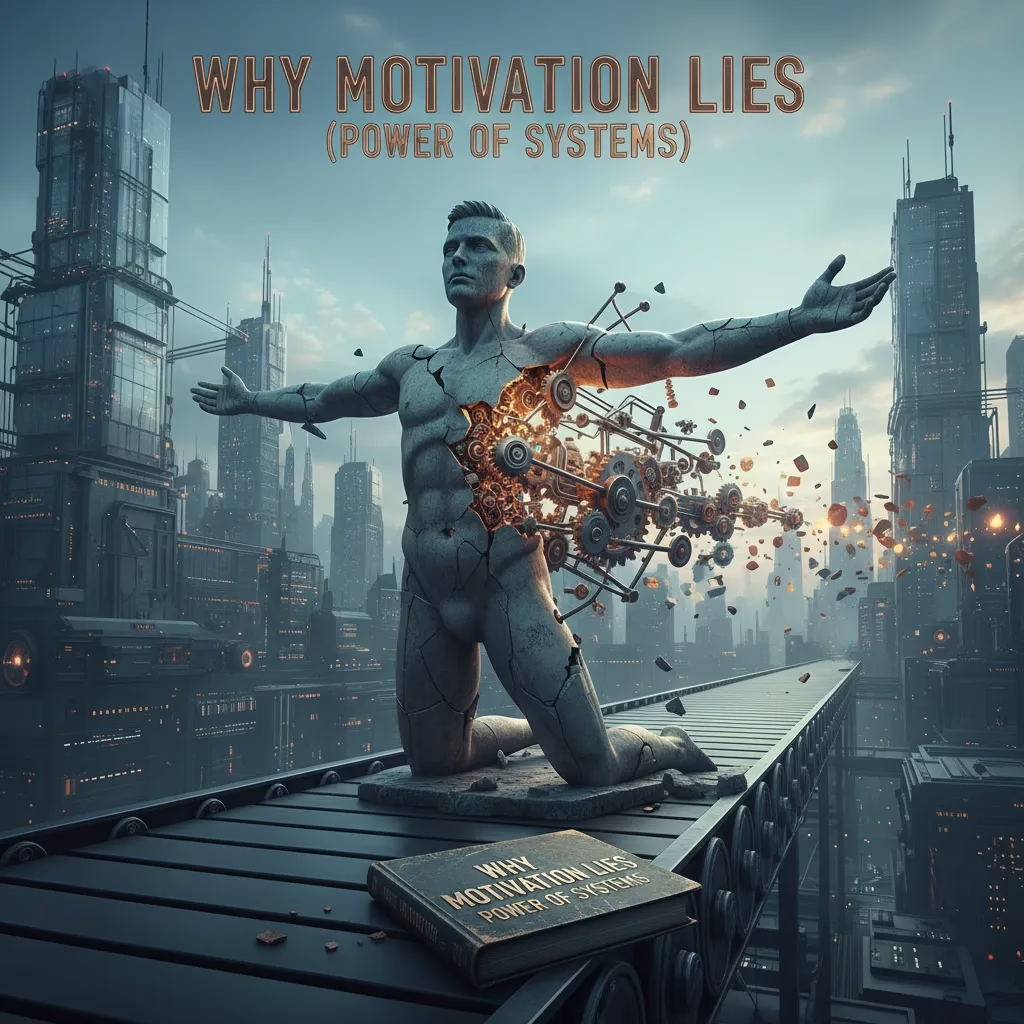
1) Why Motivation Lies (Power of systems)
I’ve watched myself promise “I’ll start tomorrow” more times than I care to admit. Same with “next week” and the classic “January 1st.” Motivation loves those phrases because they sound like progress without requiring action. It sells hope, not results.
Motivation is emotional and temporary. Some days I wake up ready to take on the world. Other days I feel flat, distracted, or tired. If my income depends on how I feel, then my income will be random. That’s the real problem in the motivation versus systems debate: motivation is a spike, but business needs repeatable behavior.
You do not rise to the level of your goals. You fall to the level of your systems. — James Clear
That quote hit me because it explains what I saw in myself. I would set a big goal, get fired up, and sprint for a few days. Then life happened. The sprint ended. The goal stayed on the wall, untouched. Systems don’t care about hype. A system just runs.
Motivation versus systems: spikes vs. steady output
When motivation shows up, it feels like a superpower. I’ll write a post, update my bio, maybe even build a landing page. Then I disappear for two weeks. That’s not consistency—that’s a mood swing.
The Power of systems is that they turn one burst into a routine. Systems focus on daily routines rather than distant outcomes. Instead of asking, “Do I feel like working today?” the system asks, “What’s the next step on the checklist?”
Example: one random post vs. a posting system
I used to post only when I felt inspired. That meant I’d drop one strong piece of content after a burst of energy… and then nothing. No backlog. No plan. No momentum.
A simple posting system changed that. It looked like this:
-
Topic map: 4–6 core themes I can repeat (so I’m never stuck)
-
Frequency: a realistic schedule (ex: 3 posts/week)
-
Backlog: a running list of drafts and ideas (so I’m not starting from zero)
-
Workflow: outline → write → edit → publish (same steps every time)
That’s the difference between “I posted” and “I have a system that produces posts.” One is a moment. The other is output you can count on.
Systems are flexible (and that’s why they survive real life)
Goals are rigid: hit the number or fail. Systems are adaptable. If my week gets chaotic, I can scale the system down without breaking it. That’s why Systems are flexible: they adjust to reality while still keeping execution alive.
In uniform, we didn’t rely on motivation. We relied on checklists, repetition, and structure. Online business is the same. Automation beats hustle. A funnel beats random links. A posting system beats random content. When motivation fades—as it always does—the system still executes.
2) Military Checklists to Content Funnels (Use habits and routines)
I learned early that in the military, routines and checklists weren’t “nice to have.” They were the difference between clean execution and chaos. We didn’t wake up and feel like doing pre-checks. We did them because the mission didn’t care about our mood. The checklist saved time, prevented mistakes, and sometimes saved lives.
That’s why the online business world always makes me laugh a little when people say, “I’m just not motivated to post.” In uniform, nobody asked if you were motivated to show up. You showed up because the system told you what to do next.
Use habits and routines: the business version of a checklist
When I finally stopped treating content like a creative mood swing, everything got easier. I built a simple system: a posting checklist, a basic funnel, and automation. That’s it. No hype. No hustle marathons.
Systems help you focus on the process, not the illusion of willpower. — James Clear
This matches what I’ve seen in practice and what others teach: systems give you a doable action plan and a way to track progress. Lochby’s “goals versus systems” breakdown helped me frame it clearly: goals are the target, but systems are what you do on Tuesday morning when life is loud (Lochby: https://www.lochby.com/blogs/blog/goals-versus-systems-do-both).
Daily routines habits that remove friction
Here’s the mini case that changed my output. I set a 30-minute weekly content session. Not daily. Not “when I feel inspired.” Just one short block on the calendar.
-
30 minutes to outline and draft
-
Batch 5 posts into a backlog (example metric: 1 session => 5 posts queued)
-
Load them into a scheduler so they publish automatically
Batching worked because it reduced friction. I wasn’t “starting from zero” every day. I was just maintaining a pipeline. And once I could track it—posts created, posts scheduled, posts published—I could see progress like a training log.
From random posts to a simple content funnel
A posting system beats random content. A funnel beats random links. My funnel was basic: one post leads to one free resource, which leads to one email sequence. No fancy tech stack required—just a repeatable path.
-
Post with one clear point
-
Call-to-action to a free download
-
Email follow-up that offers the next step
Team alignment blueprint: rally your team around the process
When I worked with small teams, I noticed something: it’s easier to rally people around a Team alignment blueprint (a step-by-step process) than a big, emotional goal like “go viral.” ModelThinkers-style frameworks helped me keep it simple: define the steps, assign owners, and measure the output. Step-by-step systems create buy-in because everyone knows what “done” looks like.
Motivation fades. Checklists don’t. Systems execute.

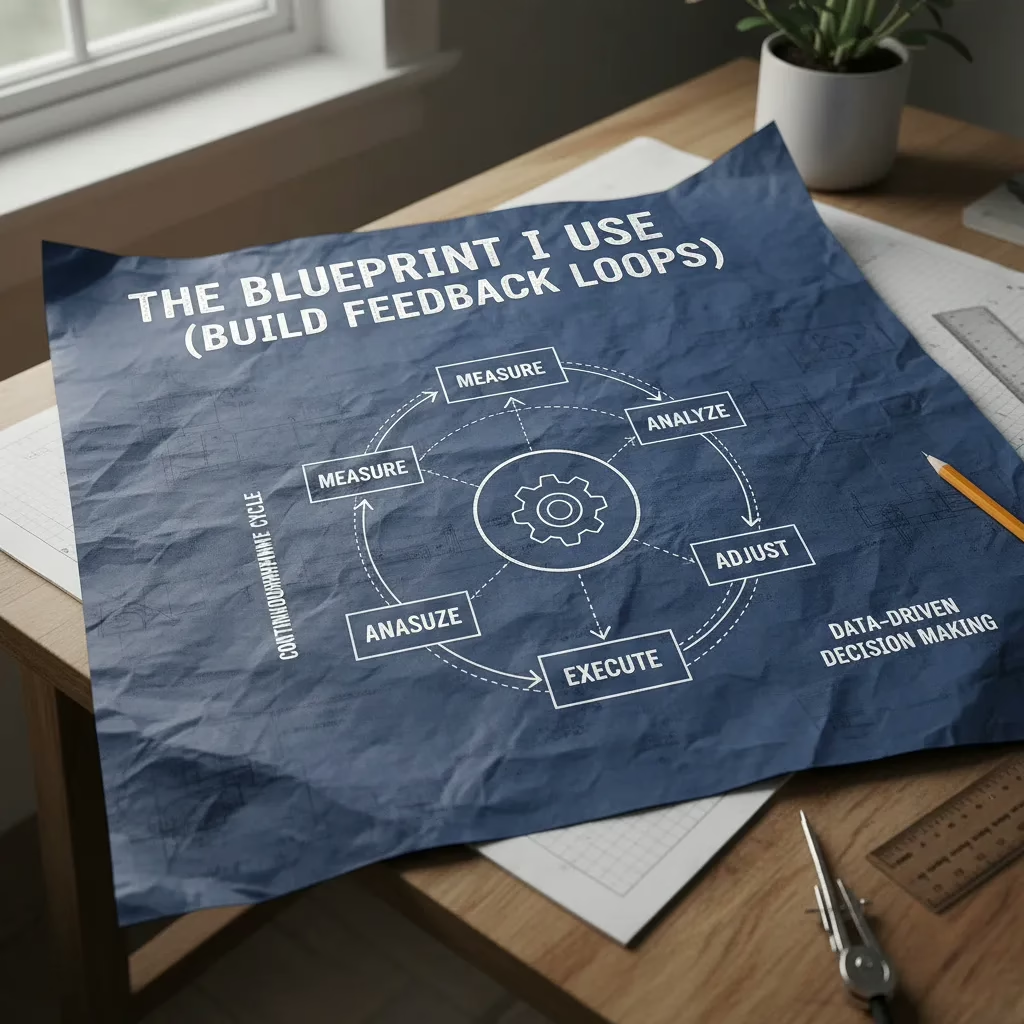
3) The Blueprint I Use (Build feedback loops)
I used to think I needed more drive. More “push.” But the truth is, motivation is a mood. And moods don’t pay bills. So I built a system that works even when I’m tired, distracted, or not feeling it.
I keep things embarrassingly simple: calendar blocks, a two-step funnel, and one metric to watch. That’s my feedback loop. A system doesn’t ask how you feel. It executes.
You should focus on systems — the measurable, repeatable process — rather than a one-off goal. — James Clear
My Action plan structure (cadence → template → automation → KPI → iteration)
This is the action plan structure I run every week. It’s boring on purpose, because boring is repeatable.
-
Decide cadence (how often I publish and promote)
-
Create templates (so I’m not reinventing the wheel)
-
Automate distribution (so consistency isn’t “willpower-based”)
-
Measure one KPI (so I know what’s working)
-
Iterate (fix one thing, then repeat)
The reason this works is simple: systems give you immediate feedback loops. Metrics tell you what to adjust. Without that, you’re just guessing and calling it “grind.”
What my week actually looks like (calendar blocks)
I block time like I’m back in uniform—because it removes decision fatigue. Two focused blocks is enough:
-
Build block (60–90 min): write one piece of content using a template
-
Distribution block (30–45 min): schedule posts + send one email
This is where systems adaptability flexibility matters. If life hits hard, I don’t “quit.” I shrink the blocks and keep the chain unbroken.
The two-step funnel (simple on purpose)
I don’t run a complicated maze. I use a two-step funnel because it’s easy to track and improve:
-
Lead magnet (one clear promise)
-
Email signup (one clear next step)
If I hit a goal once without systematizing it, it’s not scalable. It’s luck. The funnel turns luck into a process I can repeat.
Progress tracking improvement: the one KPI I watch
I track one number weekly: conversion rate from lead magnet to email signup. That’s it. If it drops, I don’t panic—I diagnose.
|
KPI |
How I track it |
What I change if it dips |
|---|---|---|
|
Conversion rate (%) |
|
A/B test one element (headline, CTA, or form) |
This is my continuous improvement approach: one metric, one change, one week. Systems win because they’re built to be upgraded. The success isn’t “getting it right.” It’s iteration—finding the flaw, fixing it, and running the loop again.
4) Wild Cards: Analogies, Hypotheticals, and Small Tangents (Keeps you grounded)
Motivation is a sparkler. Systems are a lighthouse.
I used to treat motivation like it was the plan. When I felt it, I moved fast. When I didn’t, I stalled. That’s when I realized motivation is basically a sparkler—bright, exciting, and gone before you can build anything real.
A Systems based mentality is the opposite. Systems are a lighthouse. Not flashy. Not emotional. Just steady light, night after night, telling you where to go even when the weather is bad. That’s what a posting schedule does. That’s what a funnel does. That’s what automation does. It Keeps you grounded when your feelings try to drag you out to sea.
The odd-numbered days thought experiment
Here’s a hypothetical I use when I catch myself waiting to “feel ready.” If you only felt motivated on odd-numbered days, what would your business look like?
You’d post on the 1st, disappear on the 2nd, come back on the 3rd, and ghost again on the 4th. Your audience would never know what to expect. Your income would wobble. Your confidence would drop because you’d keep breaking promises to yourself.
That’s the absurdity of motivation. It turns consistency into a coin flip. Sustainable system creation fixes it by making the work automatic. The system doesn’t care if it’s an even day. It just runs.
Small tangent: process joy beats goal joy
Quick human aside: I used to think I’d be happy after I hit the goal. After the first $1K month. After the first big launch. After the “proof.” But goal happiness is conditional. It’s like holding your breath until the scoreboard changes.
What’s steadier is the satisfaction of running the process. I can finish my daily content block, check my leads, follow up, and know I did the reps. That’s a win I can collect today, not someday. Like James Clear said:
Relying on systems gives you a daily win regardless of whether the final goal has been reached. — James Clear
Why systems get buy-in when goals don’t
Big-picture goals sound nice, but they’re hard to rally people around—especially when the goal is far away and life is loud. Systems focus on immediate choices and daily routines. That’s why teams buy in faster. “Do this today” is clearer than “someday we’ll be great.”
If you want freedom, stop chasing hype. Build boring systems that print results. That’s how you win long term.
TL;DR: Motivation is emotional and temporary. Systems are repeatable and scalable. Stop banking on feelings—build simple routines, feedback loops, and automation to turn effort into predictable income.