
I used to wait for a surge of motivation: a good morning, a bold idea, a caffeine-fueled evening. Some weeks I moved mountains. Other weeks? Crickets. On 2026-01-17 I wrote down the question that changed everything: “What would this look like if it ran without me?” That question forced me out of trying harder and into becoming someone who builds systems. In this post I’ll walk you through that identity shift, the three systems I built (posting schedules, funnels, repeatable workflows), and the exact, human steps I used to stop relying on mood and start relying on who I believed I was.
1) The Motivation Trap (and my messy wake-up call)
Motivation vs identity: what I thought I needed
For a long time, I believed my online business problems had one simple fix: more motivation. If I could just feel “on” more often, I’d post more, sell more, and finally feel like a real business owner.
But what I got instead was a cycle of inconsistent results. I’d have a great week—content flowing, DMs coming in, a few sales—and then… silence. No posts. No outreach. No momentum. Just me staring at my laptop, waiting to feel ready again.
My pattern: momentum, then burnout (repeat)
It was always the same two-step pattern: momentum, then burnout. When motivation showed up, I sprinted. I tried to do everything at once—create, market, sell, improve my offer, redesign my site. Then I crashed.
That inconsistency cost me income and sanity. Income, because my business only “worked” when I was emotionally charged. Sanity, because every slow week felt personal—like proof I wasn’t cut out for this.
That’s the trap: motivation is emotional and unreliable. It’s a spark, not a structure. And when your business depends on sparks, you live in a constant state of pressure.
You do not rise to the level of your goals. You fall to the level of your systems. — James Clear
2026-01-17: the question that flipped the script
On 2026-01-17, I hit one of those messy moments where I couldn’t ignore the pattern anymore. I wasn’t failing because I lacked ideas. I was failing because I had no repeatable way to execute them.
So I asked a simple question that changed how I think about work:
“What would this look like if it ran without me?”
That question forced an identity shift. It moved me from being a person who “tries when inspired” to someone who builds operations. It took me out of reacting and into designing.
The accidental metaphor: online business systems, not inspiration
Even the featured image from that day stuck with me: a military crew working inside a control tower (1024×576). Not because it looked cool, but because it felt like the opposite of my approach. They weren’t waiting for motivation. They were running a system—checklists, roles, timing, communication.
That became my metaphor for online business systems: operations over mood, structure over hustle, repeatable actions over random bursts.
People don’t buy what you do; they buy why you do it. — Simon Sinek
2) Identity: The Operational Backbone
I used to wake up and ask, “How do I get motivated today?” And if the answer wasn’t there, my business didn’t move. That’s when I realized motivation is emotional. It rises and falls. But identity is operational. It gives you a baseline—something you run on even when you don’t feel like it.
So I changed the question to: “Who am I in this business?” That one shift started changing my behavior without me trying to “pump myself up.” When I saw myself differently, my routine choices became default behaviors. I didn’t need a mood. I needed a role to play.
Every action you take is a vote for the type of person you want to become. — James Clear
My identity shift happened in three clear transitions
It helped me to list the changes like labels I could step into. Not vague goals—real self-relabeling. Here are the three identity shifts that changed everything for me:
- side-hustler → operator
- creator → system builder
- reacting → executing
The side-hustler to operator shift meant I stopped treating my business like something I “fit in” after life. Operators protect time. Operators plan. Operators don’t wait for perfect conditions.
The creator system builder
And the reacting → executing shift meant I stopped letting my inbox set my priorities. I chose one plan for the day and finished it, even if it was boring.
If you can’t describe what you are doing as a process, you probably don’t have a sustainable business. — Ben Horowitz
The day I felt “official”
About a week after I wrote this post, I blocked two hours on a random morning and scheduled a full month of posts. Not because I was overflowing with ideas—because I had a process. When I clicked “schedule” on the last one, I felt weirdly calm. Official. Like I had crossed a line from trying to running.
Small identity votes (one task = one vote)
I didn’t become an operator in one big moment. I became one through small, repeatable actions. Each task I completed was one vote for the person I wanted to be:
- Writing even when it wasn’t fun
- Documenting a process instead of winging it
- Scheduling content instead of waiting for inspiration
That’s the power of an identity shift: it turns consistency into something you do by default, not something you fight for every day.

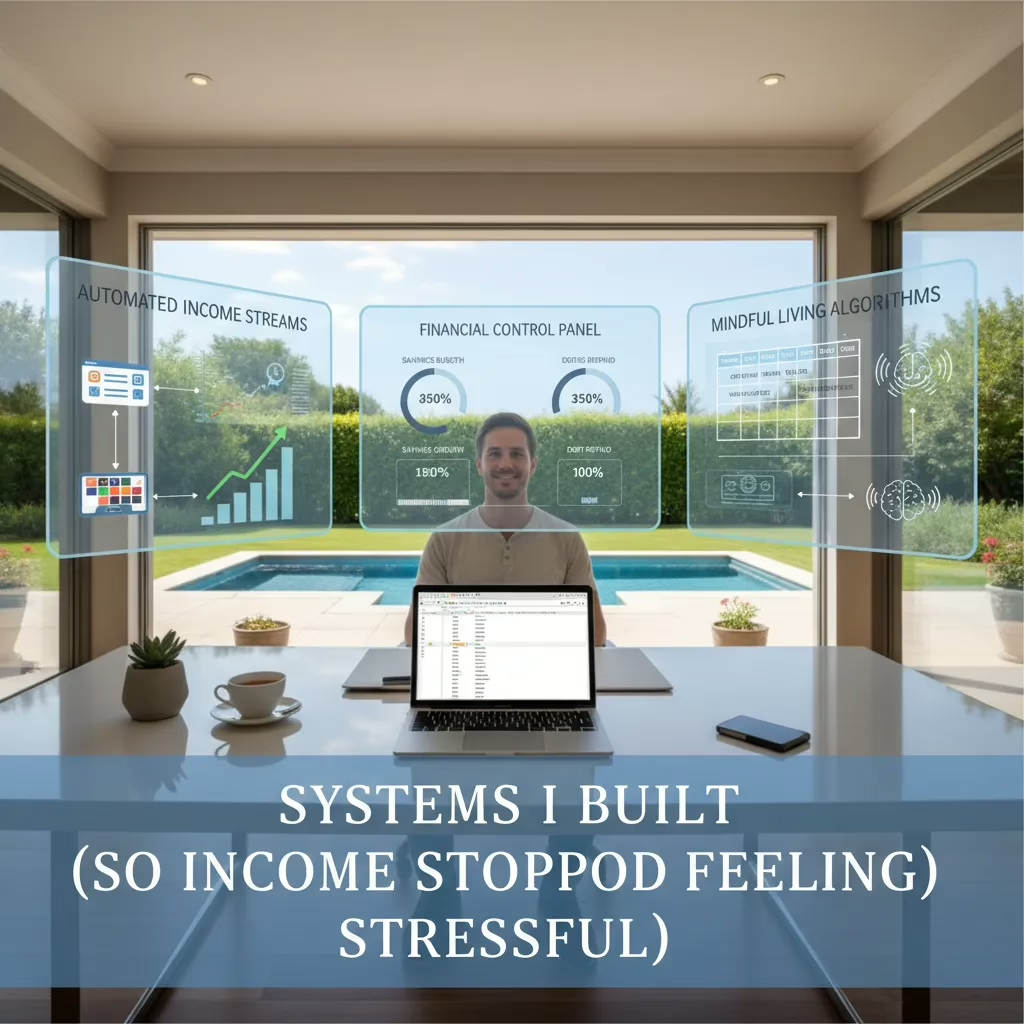
3) Systems I Built (so income stopped feeling stressful)
When my income felt shaky, it wasn’t because I lacked talent. It was because I kept waiting to feel ready. Motivation gave me random bursts. Then it disappeared. So I asked the question that changed everything: “What would this look like if it ran without me?”
You do not rise to the level of your goals. You fall to the level of your systems. — James Clear
That question pushed me into building online business systems—three simple ones that turned irregular effort into predictable outcomes.
System #1: Posting schedules (calendars replaced hope)
I traded inspiration for a content marketing strategy I could follow even on low-energy days. The goal wasn’t “post more.” The goal was “remove decisions.” Batching content reduced decision fatigue and kept consistency high.
Here’s the mini-walkthrough I still use:
- Plan: pick 4 topics for the week (one per core offer/problem).
- Batch: write and record in one block (I batch 4 posts/week).
- Publish: schedule everything for the next 4 weeks.
- Measure: track saves, replies, clicks—then repeat what works.
Once the calendar was set, I stopped negotiating with myself every morning. Consistency became normal, not heroic.
System #2: Funnels (predictable paths, not wishful thinking)
Attention is nice. Income needs a path. So I built simple funnels for creators—not complicated, not fancy. Just a basic 3-step funnel that moves someone from visibility to conversions:
- Lead magnet: a checklist, template, or short guide that solves one small problem.
- Nurture sequence: 5–7 emails that teach, share proof, and build trust.
- Offer: one clear next step (call, product, or package).
Small imperfect aside: my first funnel leaked like a sieve. People downloaded the freebie and vanished. But it taught me exactly where to plug holes—better subject lines, clearer CTAs, and one email that actually asked for the sale.
System #3: Repeatable workflows (so I stopped reinventing everything)
Finally, I documented repeatable workflows for client onboarding, content, and email sequences. I wrote them like checklists, not essays. When I felt scattered, I followed the steps.
Systems create freedom; hustle creates chaos. — My own line
The result was simple: less firefighting, more predictable weeks, and fewer emotional roller-coasters. I wasn’t “trying harder.” I was operating like the kind of person who builds systems—and then lets them carry the weight.
4) How to Shift Your Identity (practical, messy, human steps)
The real fight in motivation vs identity isn’t in your calendar. It’s in your self-image. When I stopped asking, “Do I feel like doing this today?” and started asking one operational question, everything got calmer:
“What would this look like if it ran without me?”
I treat that question like a control tower checklist. The featured image makes me think of operations: planes don’t take off on vibes. They take off on systems, checklists, and clear signals. Online business is the same.
Step 1: Ask the operational question daily (and write the answer)
Every morning, I write one sentence: Would this work if I wasn’t here? Then I write the next smallest fix. Not a big reinvention—just one lever. This is how you move from creator system builder thinking.
Step 2: Build one small system first (not ten)
Pick one system that supports your content marketing strategy:
- Schedule next month’s posts (even if they’re rough drafts), or
- Map a simple 3-step funnel: post → opt-in → offer
That’s it. Identity shifts faster when you stop collecting tactics and start operating one machine.
Step 3: Track “identity votes” so progress feels real
Each completed task is a vote for your new identity: operator, builder, executor. I track votes in a tiny habit log so I can see psychological progress.
| Task | Completed (Y/N) | Identity vote |
|---|---|---|
| Write 1 post outline | Y | I am consistent |
| Map funnel step | N | I keep promises |
Small habits compound into big identity changes. — James Clear
A repeatable 7-day mini plan (simple, not perfect)
- Day 1: Answer the question: “Would this work if I wasn’t here?” Write one fix.
- Day 2: Map your 3-step funnel on paper (or in a doc).
- Day 3: Batch content: 3 hooks + 3 outlines.
- Day 4: Draft one post and add a clear CTA to the opt-in.
- Day 5: Build the opt-in page (ugly is allowed).
- Day 6: Write the follow-up email (one email is enough).
- Day 7: Schedule posts + review your habit log votes.
Expect clumsy launches (mine were)
My first funnel “launch” was embarrassing. The link broke, the email went to spam for some people, and I got zero sign-ups. Old me would’ve called it proof I wasn’t cut out for this. New me treated it like operations: patch, test, rerun. I fixed it twice, and it eventually produced steady leads.
The cost of being wrong is less than the cost of doing nothing. — Seth Godin
5) Wild Cards, Analogies, and Slightly Weird Exercises
Wild Card #1: The control tower test (systems not hustle)
Every time I look at the featured image—the military control tower photo (2025/11 upload path)—I remember what I used to get wrong. I treated my business like a fighter jet: fast, loud, and powered by adrenaline. That’s hustle. But real growth comes from the tower: calm signals, clear rules, and repeatable checks.
In an air traffic control tower, nobody “feels motivated” into safety. They design the signals, then step back and trust the process. That’s what online business systems are: the signals that keep leads, content, and sales moving even when my mood changes.
Wild Card #2: The 1-year-without-you thought experiment
Here’s a simple hypothetical that forces an identity shift: imagine your business has to run for 1 year without you. No posting “when you feel like it.” No last-minute launches. No saving the week with a burst of energy.
Ask: what breaks first? Then fix that first. Worst-first is the fastest way to build stability.
- If leads stop: build one evergreen opt-in + a simple follow-up sequence.
- If sales stop: tighten one offer page + one checkout flow.
- If delivery collapses: document your onboarding and weekly client steps.
- If content disappears: create a posting schedule you can follow on your worst day.
Wild Card #3: Two quotes that keep me operational
When I’m tempted to chase motivation again, I come back to these:
You do not rise to the level of your goals. You fall to the level of your systems. — James Clear
People don’t buy what you do; they buy why you do it. — Simon Sinek
To me, that’s the full picture: systems not hustle keeps the plane in the air, and “why” gives the flight a destination. Together, they turn random effort into real operations.
Wild Card #4: The 10-minute resignation letter (slightly weird, very effective)
This is my favorite fast exercise for identity change. Set a timer for 10 minutes. Write a resignation letter to your “side-hustler” self. Keep it simple and direct. Then read it weekly.
- Start with: “Dear Side-Hustler Me…”
- Name what you’re quitting: last-minute posting, waiting for confidence, chasing perfect content.
- Name what you’re becoming: operator, system builder, executor.
- End with one promise: the next system you’ll install this week.
Small tangent: I used to obsess over perfect content. I thought polish would save me. It didn’t. It just delayed shipping. The tower doesn’t need perfect planes—it needs clear signals. That’s the real identity shift: from “creator who hopes” to “operator who runs online business systems.”
6) Conclusion: Rewriting Who You Are (and the practical next steps)
On 2026-01-17, I looked back at the way I used to run my business—like a crew in a control tower staring at screens, waiting for the next signal. That’s what motivation felt like: alert one day, quiet the next. The image in my head is still that same scene: lots of activity, but no steady flight plan. And that’s the point. Motivation will come and go. Identity is the engine that keeps your online business moving when the feelings don’t show up.
Motivation fades. Identity runs the machine.
I used to think I needed a better mood, a stronger push, a new burst of energy. But the truth was simpler: I needed an identity shift. When I started seeing myself as an operator, I stopped waiting to “feel ready.” I started building online business systems that could carry the work even on average days.
You do not rise to the level of your goals. You fall to the level of your systems. — James Clear
Stop changing tactics. Change the story you tell about yourself.
If you’re stuck, it’s tempting to swap tools, buy another course, or rewrite your entire content marketing strategy. I’ve done that. More than once. But the bigger change was internal: I stopped calling myself “behind” and started calling myself “in training.” I stopped saying “I’m not consistent” and started saying “I’m building consistency.” That story matters because it decides what you do next.
The 3 systems I started with (and still return to)
Everything changed when I asked, “What would this look like if it ran without me?” My next steps were small and repeatable: schedule, funnel, document—repeat. Not ten systems. Not a perfect plan. Just three core systems that turned chaotic effort into consistent income over time.
Small steps repeated lead to remarkable results. — My own reflection
Here’s a simple way to make it real: track “identity votes” daily. Each day you keep a promise—publish, follow up, improve one page—you cast a vote for the person you’re becoming. I’m still casting those votes too.
Your challenge: one hour of “operator practice”
This week, schedule one hour and name it operator practice. In that hour, build one small piece of a system: outline next week’s posts, clean up one funnel step, or document a repeatable process. Then tell me what you did—drop it in the comments or DM me. I’ll read it, because I’m still improving too, and I’m building this identity right alongside you.
TL;DR: Swap ‘more motivation’ for an identity upgrade. Build schedules, funnels, and systems so your business runs whether you feel like it or not.