
I came out of the military with an arsenal of discipline—and a false belief: that effort alone would make my online business succeed. I learned the hard way that waking up earlier and grinding longer didn’t create compounding results. In this post I’ll walk you through why discipline is necessary but not sufficient, how leverage and systems change the math, and the exact belief shifts and automation moves that turned my sprint into a self-sustaining engine.
My Opening: The Military Mindset Meets Online Hustle
Veteran Entrepreneurship: I Brought the Right Traits—And the Wrong Plan
The military taught me discipline. Early mornings. Checklists. Mission focus. If something wasn’t working, my answer was simple: do more. That mindset served me in uniform, and I assumed it would carry me through online business too.
So I showed up like it was a field problem. I tracked tasks, blocked time, and treated every day like a mission brief. I believed the grind was the strategy.
Discipline vs Leverage: The Week I “Pushed” and Still Didn’t Win
My first real attempt at momentum was a one-week product push. I wrote posts, sent messages, followed up, and stayed up late “finishing the mission.” For seven days, I was locked in.
It worked—kind of. I got a few sales and a quick spike of attention. Then the week ended, and so did the results. No compounding. No steady pipeline. Just exhaustion and a quiet question I didn’t want to ask: If I’m this disciplined, why isn’t this growing?
That was my first hard lesson in discipline vs leverage. Discipline created effort. It didn’t create scalable income.
The Email “PT Session” That Exposed My Blind Spot
Here’s the part that still makes me laugh: I once treated email like morning PT. I’d hit the inbox hard, clear it fast, and feel accomplished. But it was intense work with low long-term ROI. The next day, the inbox refilled. Nothing improved. Nothing automated. Nothing built authority while I slept.
If You’re Wired Like Me, This Will Feel Familiar
If you’re a veteran, ex-military, or just a highly regimented professional, you’ve probably tried to outwork the problem. Many of us enter veteran entrepreneurship with strong discipline—but without leverage strategies. We can create short-term wins, but not compounding growth.
“Discipline equals freedom.” — Jocko Willink
I still believe that. I just learned freedom in business also requires leverage.
- Discipline: showing up
- Leverage: making results repeat
- Systems: turning chaos into process
- Automation: letting work run without you
- Authority: earning trust through repeatable outcomes
“What we fear doing most is usually what we most need to do.” — Tim Ferriss

Why Discipline Is Necessary—but Insufficient
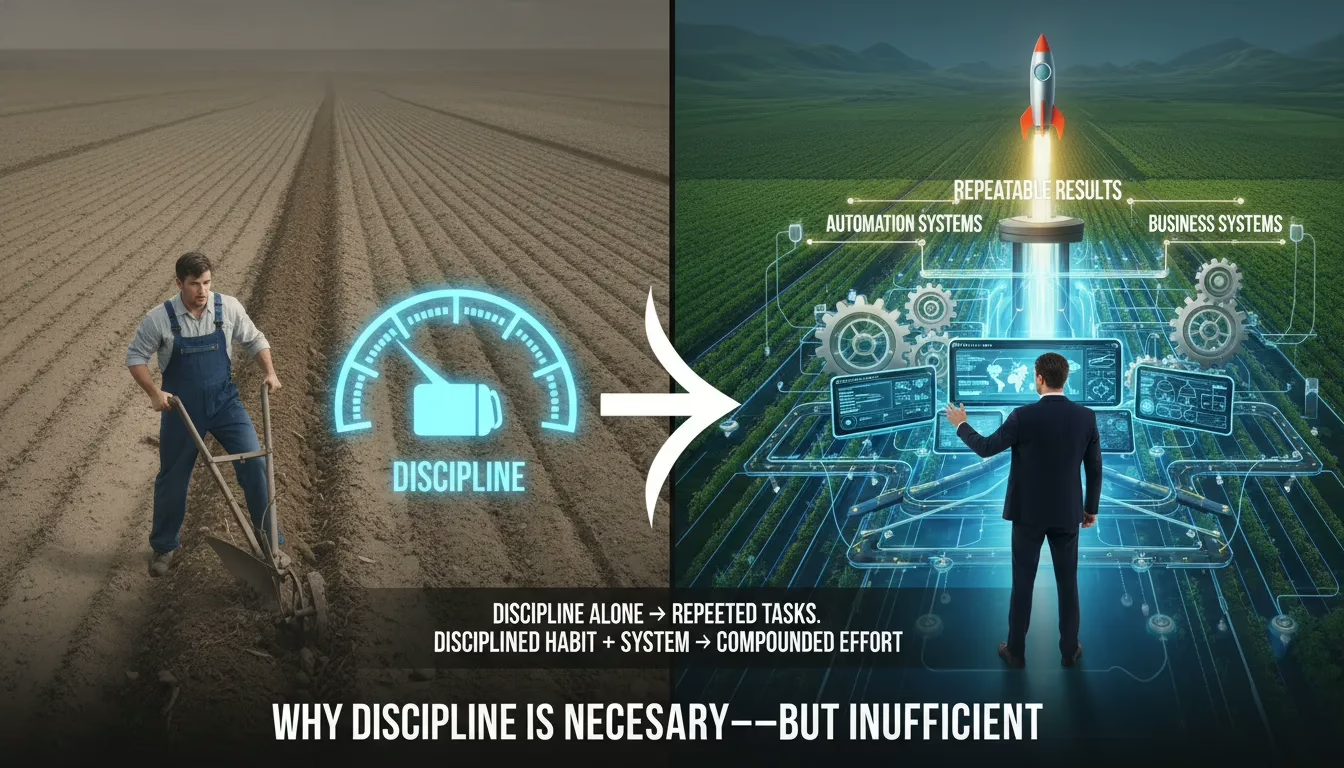
I still value discipline. It’s the fuel that gets projects off the ground. The military wired me to show up, even when I don’t feel like it. And that matters in online business—because nobody is coming to make you do the work.
Nir Eyal: “Habits are the compound interest of self-improvement.”
But here’s what I learned the hard way: discipline by itself is manual labor. It creates repeated tasks, not scalable outcomes. I can grind through a to-do list all day and still end up in the same place tomorrow—because nothing is built to keep working without me.
Consistency Is Good. Brute Force Effort Is the Trap.
Consistency means I publish, I follow up, I improve. Brute force effort means I do the same thing the same way, just harder. That’s where veterans get stuck. We mistake “more reps” for “better design.” In business, business systems are what turn consistent effort into repeatable results.
My Content Lesson: Writing Daily vs. Designing Distribution
I used to think the answer was simple: write every day. So I did. And it helped—until I realized I was creating one asset at a time, then letting it die in one place. The shift was building a syndication strategy: one post becomes an email, a short thread, a LinkedIn post, and a republished version on another platform. Same discipline—different outcome—because the system multiplies the work.
When Discipline Turns Into Tunnel Vision
In training, rigid routines worked because the goal was clear and the environment was controlled. But creative work isn’t like that. Too much discipline without flexibility gave me tunnel vision. I kept executing a plan that wasn’t producing, instead of stepping back and redesigning the process.
Amy Porterfield: “Consistency beats intensity when you build systems.”
Mini-Action: Audit One Habit for Automation Systems
- Pick one disciplined habit you do weekly (posting, invoicing, follow-ups).
- Ask: How can this scale?
- Run a simple 30-day audit to find the first low-hanging automation opportunity.
- Convert one manual task into an automated or repeatable process within 30 days.
Keep the discipline. Just redirect it toward building systems that compound.
Effort vs Leverage: Changing the Mental Math
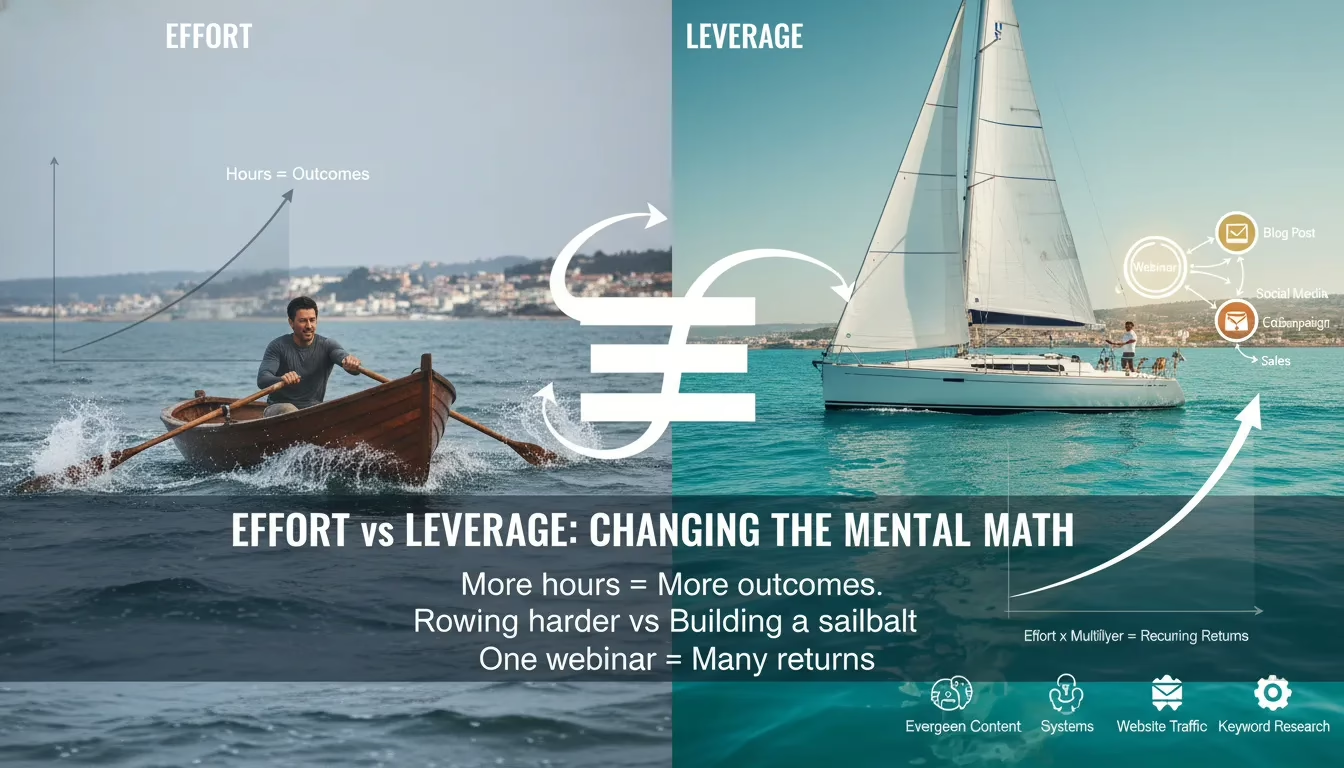
I used to believe the math was simple: more hours = more outcomes. That mindset worked in the military. In an online business, it can keep you stuck. Because effort is linear. You push, you get a result, and then it stops. Leverage in business is different. It turns one good move into recurring returns—so progress can keep showing up even when you’re not.
Rowing Harder vs Building a Sailboat
Here’s the picture that finally clicked for me: rowing harder and building a sailboat both move you forward. But rowing demands constant force. A sailboat uses a system—wind, sail, and direction—to multiply the same goal with different mechanics. That’s leverage. Same direction. Less burnout. More compounding.
One Effort, Many Returns (Webinars + Repurposing)
I learned this when I ran a workshop that went well… and then I let it die on the calendar. Later, I repurposed that single session into an evergreen webinar, a short email sequence, and a few clips. That one change doubled my monthly leads without doubling my hours. Same effort once, returns many.
SEO Leverage: Evergreen Content + Keyword Research
Leverage isn’t only funnels and webinars. It’s also search. An evergreen blog post can bring website traffic for months if it targets the right intent. That’s why keyword research matters. Tools like Semrush and WordStream help you find long-tail keywords that are easier to rank for and stay relevant longer. If you’re local, Google My Business can be a quiet multiplier too.
Seth Godin: “Don’t find customers for your products, find products for your customers.”
A Simple Leverage Test (Aim for 5–10x)
- Ask: “If I spend 1 hour here, can it create 5–10 hours of impact later?”
- Turn live work into assets: webinar → emails → posts → blog.
- Build systems: templates, automations, affiliate partnerships, simple funnels.
Warning: leverage often costs more upfront—time, focus, and faith that the system will hold. But that’s the trade: short-term grind for long-term momentum.
Why Systems Outperform Motivation Every Time
Motivation is a spark. Systems are the engine I learned to build. In online business, I can’t bet my income on how I feel on a Tuesday. That’s why I now choose systems over willpower. Motivation is variable. Systems are predictable—and predictable is what compounds.
I used to run on “willpower weekends.” I’d batch content, answer every DM, and swear I’d stay consistent. Then Monday hit, life got loud, and my output crashed. I plateaued—not because I was lazy, but because my process depended on a mood. Once I documented SOPs and added automation, the work stopped depending on me being “on.”
Cal Newport: “Automation separates the amateur from the pro.”
Annie Duke: “A system will beat motivation if you stick with it.”
The Simple Difference: Variable vs Predictable
Motivation changes day to day. Systems run the same way every time. SOPs and automation reduce reliance on variable motivation, and that’s the point: I want results even when my energy is low.
My Checklist for Building Leverage
- Repeatable process: pick one task you do weekly
- Documented SOP: write the steps so it’s teachable
- Automation: use Zapier + email platforms to remove manual work
- Monitoring: track performance like a system, not a guess
- Iteration: improve one step each week
5-Step SOP Template (Copy/Paste)
- Trigger: what starts the task?
- Inputs: links, logins, files needed
- Steps: 5–10 clear actions
- Quality check: what “done right” looks like
- KPI: what number proves it worked?
Concrete Example: Email Nurture on Autopilot
I built a 7-email sequence that welcomes leads, shares proof, and offers one clear next step. A form submission triggers the sequence, tags the contact, and logs the source via Zapier. That’s leverage.
| KPIs to Monitor | What I Look For |
|---|---|
| Email open rate | Are subject lines working? |
| Conversion rate | Are readers taking action? |
| Time saved (hours/week) | Is automation paying me back? |
| Keyword impressions | Is my SEO optimization showing up? |
| Search volume / CPC | Is the topic worth building around? |
For keyword strategy, I check Keyword Planner and Semrush for search volume, CPC, competitor analysis, and Keyword Metrics. Then I build a content system that tracks impressions and improves over time.
Exercise
This month, write one SOP for a repeatable task you hate doing. Systems don’t just save time—they free creative energy for higher-leverage work.
How Authority Is Built Through Repeatable Results
When I say authority building, I don’t mean a bigger following or louder posts. I mean repeatable, clear outcomes in a specific niche—results I can show, explain, and recreate. That’s what reduces sales friction. People trust what they can verify.
I learned this the hard way. I tried to “post more” and “hustle harder,” but nothing changed until I focused on consistent wins for one audience. Then I hit a 90-day streak where clients kept getting measurable improvements—one after another. Not viral. Not flashy. Just steady. A landing page tweak that lifted conversions from 1.8% to 3.1%. A simple email follow-up that added $4,200 in 30 days. Those wins became screenshots, testimonials, and stories I could point to.
“People do not buy goods and services. They buy relations, stories, and magic.”
—Seth Godin
Turn Wins Into Case Studies (So Proof Can Work While You Sleep)
Case studies and repeatable wins accelerate authority in niche markets because they show your process, not just your opinion. My tactic is simple: document results, package them as case studies, and make them my core content.
Make Case Studies Discoverable With Long Tail Keywords
Long tail keywords help case studies rank and attract qualified traffic. I use keyword suggestions from Semrush, WordStream, and Keyword Planner to title posts like:
- “veteran-run online business systems: a 30-day lead follow-up case study”
- “automation for coaching business: 12% conversion lift case study”
“Let your results do the talking—then make your results discoverable.”
—Pat Flynn
A Repeatable System (Not Random Motivation)
- Collect data: baseline, change made, outcome (revenue, conversion rate, time saved).
- Write the story: problem → plan → proof → lesson.
- Publish monthly: 1 case study per month builds a pipeline of proof-driven leads.
- Amplify through systems: schedule emails, repurpose into short posts, add to a “results archive.”
SEO traction often takes 3–6 months, but authority compounds the moment you systemize how you generate results and how you share them.
The Veteran Advantage: Pairing Discipline with Automation
In veteran entrepreneurship, discipline is my default setting. I can plan, execute, and stay on mission when things get messy. But online business punished me for doing everything by hand. I was “productive,” yet nothing scaled. The shift happened when I paired my grit with automation systems and simple business systems that kept working after I logged off.
Ram Charan: “Execution is everything—turn plans into repeatable processes.”
My Logistics Mindset Became a Repeatable Delivery System
In the military, logistics is not motivation—it’s flow. Who hands what to whom, when, and with what standard. I brought that same mindset into my client work. Instead of reinventing onboarding every time, I built one path and made it automatic. That’s when results started to compound.
Example Workflow: From Manual Chaos to Automated Flow
Here’s a simple funnel and delivery chain I’ve used:
- Intake form submitted
- Client record created in CRM
- Automated onboarding emails sent
- Calendar booking link delivered
- Payment page + upsell funnel triggered
In plain terms:
intake form → CRM → onboarding emails → calendar booking → paid funnel
Leila Janah: “A systemized approach multiplies small acts of work into big outcomes.”
A 30-Day Automation Sprint (Veteran-Friendly)
Veterans have a natural execution advantage that multiplies with automation. A focused 30-day automation sprint can turn one manual workflow into a repeatable system:
- Map handoffs: where info moves (lead → client → delivery)
- Document SOPs: one-page checklists for each step
- Automate triggers: form submits, tags, email sequences
- Set a cadence: weekly performance review (conversion, show rate, churn)
Structure vs Creativity (You Need Both)
I used to think structure killed creativity. Now I see it differently: structure protects creativity. When my business systems handle the repeatable parts, my brain is free to create offers, write better copy, and serve clients.
Practical Tool Stack for Scalable Funnels
- Zapier for connecting apps and automating handoffs
- CRM (HubSpot or similar) to track leads and clients
- Email platform (ConvertKit/Mailchimp) for sequences
- Semrush + WordStream for SEO/ads research and discoverability
- Google My Business for local reach and trust signals
What Belief Shift Actually Unlocks Momentum
The biggest belief shift I had to make was simple: I stopped worshiping willpower and started worshiping leverage. Discipline got me moving, but it didn’t get me compounding. I was treating my business like a test of toughness instead of a machine I could build.
Carol Dweck: “Beliefs about your abilities shape your outcomes.”
Here’s what changed everything: I moved from “I must grind” to “What system can I build?” That’s systems over willpower in real life. When my inner narrative changed, my actions changed. And that’s what created momentum I could actually keep.
Quick Mental-Model Exercise: Rewrite the Script
- Old script: “If I’m not exhausted, I’m not working hard enough.”
- New script: “If it can’t run without me, it’s not a system yet.”
- Prompt: Write one sentence you repeat when you feel behind. Then rewrite it as a system question: “What checklist, template, or automation would make this easier next time?”
Swap 10 Hours of Busywork for 2 Hours of System Design
Imagine you take 10 hours a week of busywork—posting manually, rewriting the same emails, chasing leads—and trade it for 2 hours of system design plus 2 hours of maintenance. That’s not laziness. That’s leadership. It’s how you turn effort into leverage.
James Clear: “Habits and systems are the architecture of success.”
Run an 8-Week Proof Experiment (Evidence Builds Belief)
For 8 weeks, pick one process and improve it. Keep it small and measurable. Title it like an SEO-friendly tracker so you can find it later:
- “8-week lead follow-up system experiment”
- “content repurposing system to save 10 hours/week”
- “automation checklist to increase revenue per hour”
| KPI | Target |
|---|---|
| Time saved | 10 hrs/week → 2 hrs/week maintenance |
| Leads/week | Track weekly trend |
| Revenue/hour | Track weekly trend |
This shift felt like trading a sword for a compass. Brute force got replaced by direction. And once I saw even one early win, the momentum came faster than any marathon grind.
Action Plan: Build Leverage, Not Burnout (Step-by-Step)
I used to think discipline was the answer in my online business. Then I realized discipline without leverage just creates longer days. So here’s my time-boxed 8-week plan to turn effort into automation systems that compound.
Step 1 (Week 1): Audit your daily tasks
For seven days, I write down what I do in a simple log. Then I circle three actions that are repeatable or can be automated: lead capture, follow-up, posting, invoicing, onboarding. This is where leverage starts—by seeing the pattern.
Step 2 (Week 2–3): Build one SOP + one automation
I document one process into an SOP library (even a Google Doc works). Then I automate one handoff with Zapier or a basic email sequence. Example: form submission → CRM row → welcome email. Ryan Holiday said it best:
“Progress is the result of systematized action.”
Step 3 (Week 4–6): Repurpose content into a routine
I take one top-performing idea and turn it into three formats: a blog post, an email, and a social thread. This is how I get more output without more hours. It also boosts keyword impressions because the same message shows up in more places.
Step 4 (Week 7–8): Publish a case study with long tail keywords
I use Semrush and WordStream to find long tail keywords with clear intent and decent search volume. Then I publish a case study and track keyword impressions, website traffic, and clicks. If I’m local, I update Google My Business to match the offer and proof.
Step 5: Run a 30-day review and iterate
I review a simple KPI table weekly, then adjust the system—not my willpower.
| Metric | Target | Tool |
|---|---|---|
| Leads/week | Up and steady | CRM/Sheets |
| Website traffic | Trend up | Analytics |
| Conversion rate | Improve 0.5–1% | Landing page |
| Keyword impressions | Trend up | Search Console |
“Build something that helps people and they’ll help you back.”
You don’t need more willpower. You need a system that keeps working when you’re not. I share my progress publicly because it builds authority and accountability. Follow my journey—build systems that work when you don’t; join the conversation and subscribe.
TL;DR: Discipline gets you started. Leverage, repeatable systems, and automation make your work compound. Shift beliefs, build authority through results, and automate the processes that scale.
Leave a Reply
You must be logged in to post a comment.