
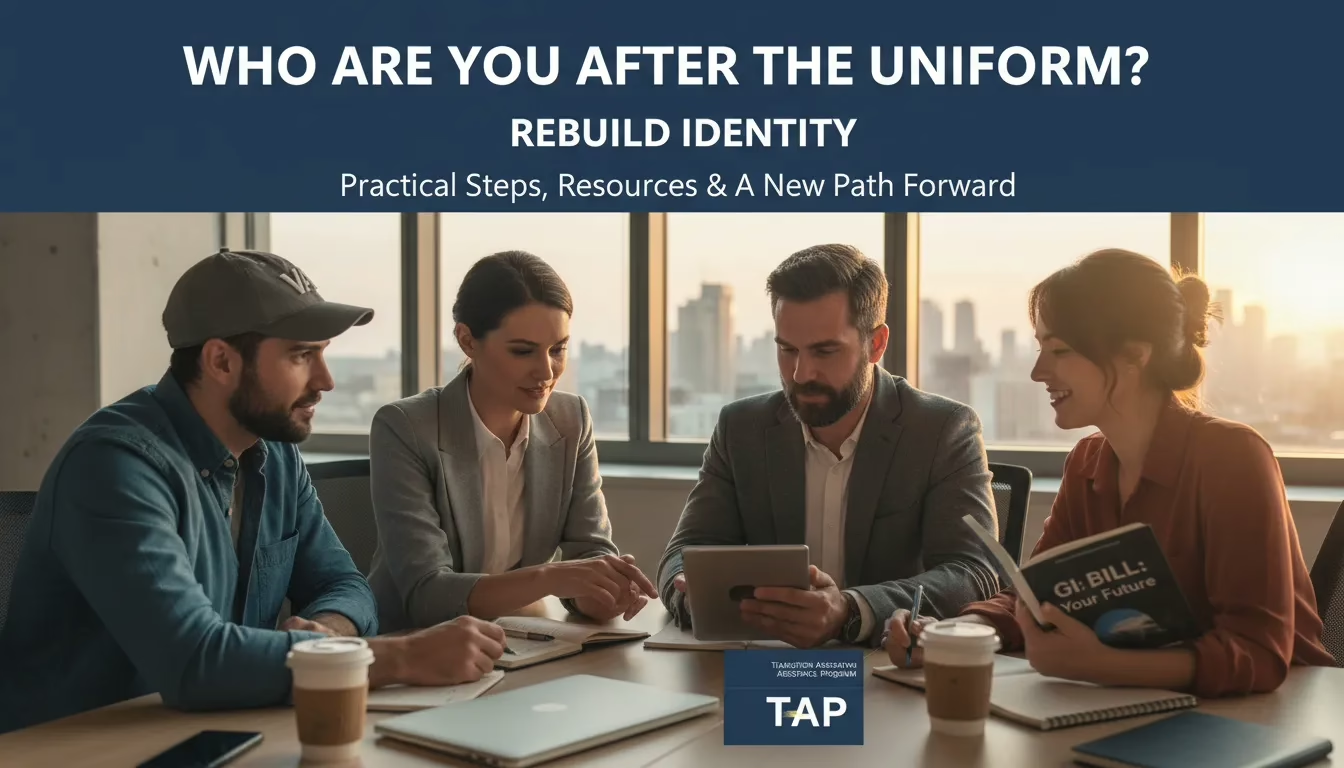
Nobody prepares you for the quiet. I still remember standing in line at Home Depot with a cart full of paint and feeling small for the first time since basic. Not the out-processing briefs, not TAP classes — that silence after the uniform comes off is a different kind of heat. I wrote this because I couldn’t find one clear roadmap that treated identity as something you rebuild, not replace. This is my attempt: honest, messy, and practical.
Opening: The Moment Nobody Told Me About
Military Transition: The Home Depot Line
Nobody prepares you for this part. Not the out-processing briefs. Not the TAP slides. Not the “thank you for your service” handshakes that feel like a clean ending.
A week after my ETS, I was standing in line at Home Depot holding a pack of screws I didn’t really need. The guy behind me was talking about deck stains like it was life or death. The cashier asked, “How’s your day going?” and I almost laughed. Yesterday I was Sergeant to some people, Captain or Chief to others. Today I was just… a guy with a cart and a receipt.
Service Members Don’t Get Briefed on the Quiet
The formal stuff in a Military Transition is clear: paperwork, benefits, timelines. What nobody covers is the informal, daily experience of identity loss—the emotional drop-off that shows up in normal places with bright lights and small talk. Research and lived experience both point to the same thing: the identity gap often hits after separation, when the structure is gone but life keeps moving.
Small public moments amplify it because there’s no rank, no mission, no “roger that.” Just silence, emptiness, and a weird aimlessness that makes you wonder if you’re doing life wrong.
Dr. Emily Carter, Veteran Transition Specialist: “The quiet after service isn’t silence — it’s an invitation to rebuild.”
Veteran Support Starts with a Reframe
I had to see identity like a container. The uniform was one container—strong, clear, issued. Now I could redesign it on purpose.
An Unexpected Aside: The Grocery Store Lesson
The first time I tried to make friendly grocery store conversation, I realized I was learning entry-level civvy skills: smiling on cue, picking a lane, not scanning for exits. It felt ridiculous. It was also real.
The Identity Gap: When Rank Stops Defining You
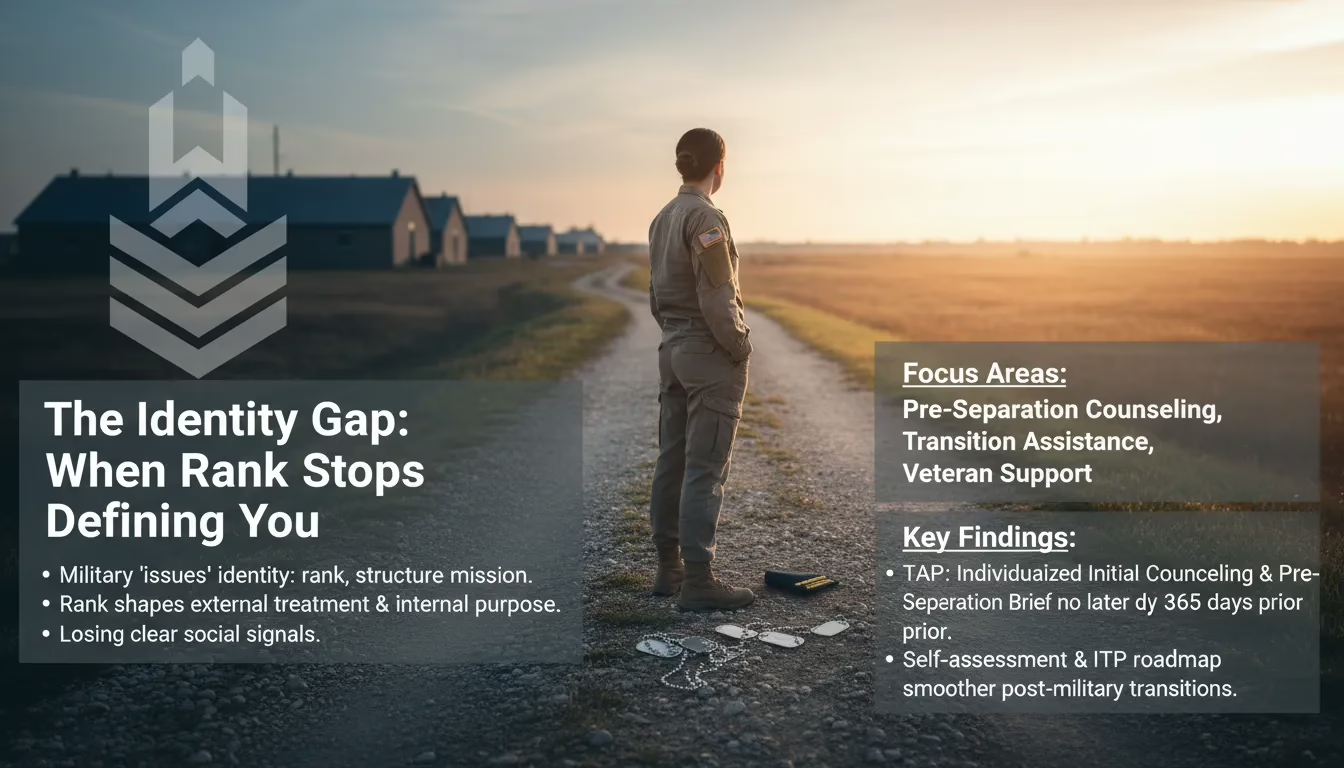
In the military, identity is issued. Rank tells people how to treat you. Structure tells you what matters. Mission tells you why you wake up. Then one day it’s gone—and that silence hits hard.
Rank isn’t just a pay grade. It’s a social signal. It tells others when to listen, when to step aside, when to trust you. It also tells you who you are in the room. Lt. Col. Marcus Hayes (Ret.), a leadership coach, said it best:
“Rank is a social shorthand — losing it requires you to write a new one.”
After the uniform comes off, the micro-interactions change. Nobody holds the door because you’re “the senior.” Nobody checks your face to see if you approve. You’re not “Sergeant” at the counter—you’re just another customer. Even small things sting: no clear chain of command, no shared language, no instant respect earned by time-in-service.
Then comes the civilian question: “So what do you want to do now?” People mean well, but it lands like pressure. In the military, the next step was often decided. Now it’s open space.
Where Pre-Separation Counseling and Transition Assistance Actually Help
TAP requires Individualized Initial Counseling and a Pre-Separation Brief no later than 365 days before transition. That matters because a good self-assessment and an ITP roadmap can reduce the identity shock. It’s not just paperwork—it’s Veteran Support for your next role.
Quick Exercise (2 minutes)
List three things the uniform used to decide for you:
-
__________________
-
__________________
-
__________________
Small tangent: I’ve seen a tiny version of this on kids’ sports teams—when the “captain” title changes, some kids feel lost. Adults do too. We just hide it better.

The Mistake: Trying to Replace the Uniform
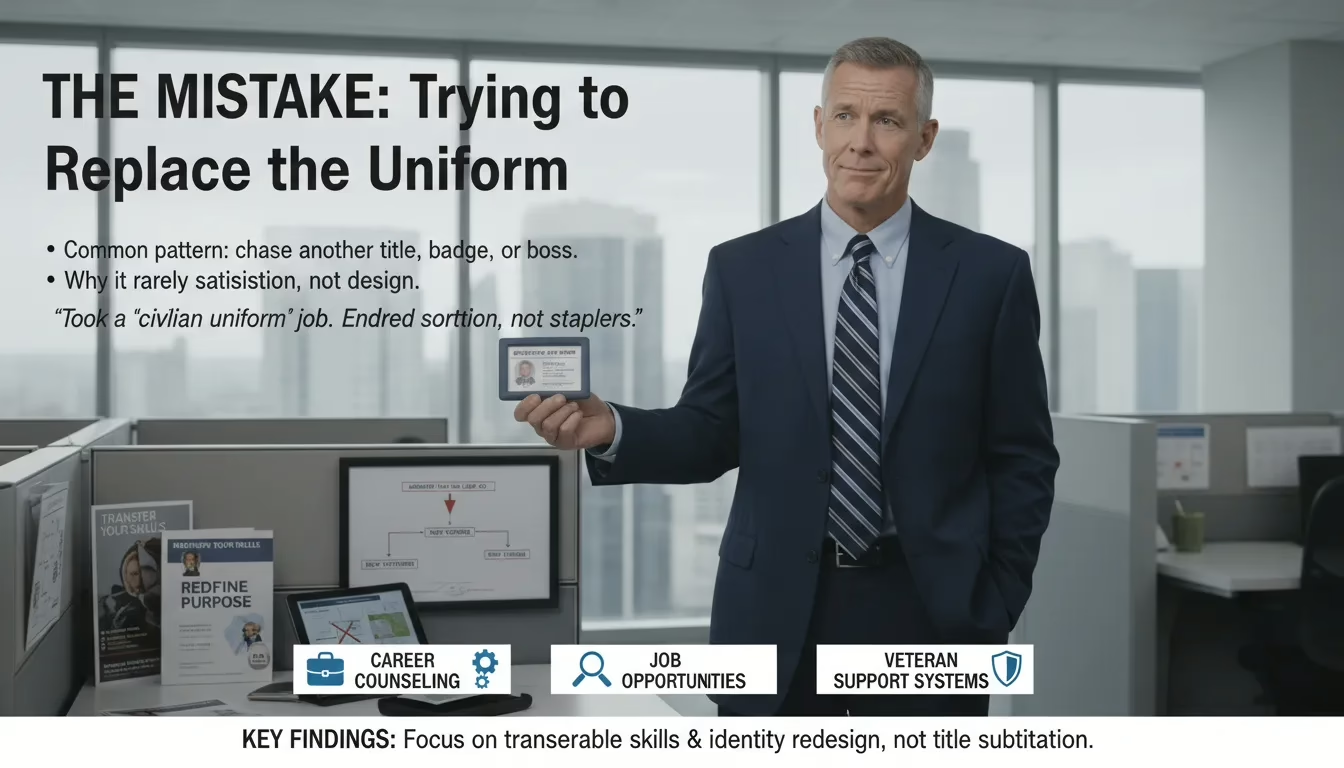
I see it over and over—because I did it too. They try to replace the uniform. Another job title, another badge, another boss. It looks like progress on paper, especially when you’re hunting Job Opportunities, but it rarely feels like peace. It’s substitution, not redesign. And identity isn’t replaced — it’s rebuilt.
Dr. Hannah Turner, Career Counselor: “Replacing a uniform with a title is like changing a coat and expecting your reflection to change.”
My “New Uniform” Mistake (Yes, I Bought the Polo)
I took a civilian role that sounded close enough to my old life—same pace, same chain-of-command vibe, same “mission” language. I even liked the pay. But I felt weirdly empty, like I’d just swapped camo for a company logo. Quick aside: short-term contract roles can feel like a uniform patch—temporary belonging without real identity.
Signs You’re Stuck in Replacement Mode
-
You keep repeating old commands: “Just tell me what right looks like.”
-
You crave external validation—titles, praise, being “the go-to.”
-
You pick roles for status, not fit.
How Employers Accidentally Reinforce It
Some hiring managers mean well, but they’ll ask, “So what were you in the military?” and then try to map you to a matching title. That language can push you back into title-chasing instead of real growth. Strong Veteran Support Systems and modern Career Counseling help by focusing on transferable skills and identity redesign—not title substitution.
Quick Diagnostic: 3 Questions
-
Am I choosing this role for who I’ll become or for what it will call me?
-
If the title disappeared, would I still want the work?
-
Am I looking for a boss to replace my chain of command?
The Reframe That Saved Me: Skills Survive the ETS
The day I turned in my gear, I felt like my value got turned in with it. Then the reframe hit me hard: You weren’t valuable because of the uniform. The uniform was valuable because of you. My Military Skills didn’t ETS. They just lost their labels.
-
Discipline (show up, finish, repeat)
-
Decision-making under pressure (act with imperfect info)
-
Systems thinking (see inputs, outputs, bottlenecks)
-
Leadership without applause (carry the team anyway)
Dr. Emily Carter, Veteran Transition Specialist: “Translating military experience into civilian terms is the single most powerful move a veteran can make.”
Inventory Your Skills (Civilian Language, Step-by-Step)
-
Write your last 3 roles (not titles—what you did).
-
Underline actions: trained, planned, fixed, led, audited, briefed.
-
Translate actions into business words: operations, logistics, compliance, customer support.
-
Match each to proof: numbers, timelines, outcomes.
-
Use TAP-OS to sanity-check benefits, timelines, and skills translation.
Small human aside: I did this in a beat-up notebook at my kitchen table—one page per job, one page per skill. It calmed the noise.
Quick Conversions + GI Bill Framework
|
Military |
Civilian |
|---|---|
|
Platoon leader |
Operations manager |
|
Combat medic |
EMS technician / healthcare operator |
Then I plugged gaps into a GI Bill Framework: the Enhanced GI Bill supports Skills-Based Learning through 2026—coding bootcamps, cybersecurity, and vocational training.
Mini-Exercise (10 Minutes)
Pick 5 job descriptions. For each, write your top 3 matching skills. Panic drops when your skills show up on paper—and momentum follows.
Where Identity Becomes Chosen: Roles That Fit
This is where veterans win—if they let themselves. You stop asking… “Who do they need me to be?” And start asking… “Who do I choose to become?” That question changed everything for me, because it made identity feel like a choice, not a vacancy.
I started prototyping roles like I was running a field test: Builder (make systems), Operator (run them), Mentor (grow people), Creator (ship ideas), Entrepreneur (own the risk). Not trendy—just fitting. And yeah, quick caution: don’t let “entrepreneur” pressure turn into another uniform.
Lt. Col. Marcus Hayes (Ret.), Leadership Coach: “Choosing your next identity is the bravest strategy — it’s intentional, not accidental.”
My “Mentor” Trial (and What It Taught Me)
I volunteered with a local youth group for eight weeks. I thought I’d be teaching discipline. Instead, I learned my real strength was steady presence—showing up, listening, and setting a calm standard. That’s a role, not a resume line.
Test-Fit Roles with Real Work
Use side projects, volunteering, or micro-contracts. Pair that with Career Counseling that uses analytics to translate military skills into civilian Job Opportunities. Community-based programs help too—they fill the network gaps the usual pipelines miss. Add Vocational Training if you need a fast skill bridge.
Pick One Role for 90 Days
-
Values: What feels worth doing?
-
Time: What can you sustain weekly?
-
Earnings need: What’s the floor?
-
Social energy: People-heavy or heads-down?
Track it in a simple journal or voice memos. After 90 days, measure more than pay: meaning, rhythm, and who you serve.
Why Systems Matter: From Freedom to Predictability
I used to think freedom would feel like motivation. It didn’t. Freedom isn’t motivation. Freedom is systems that don’t depend on your mood. When the uniform comes off, the structure disappears—and that’s where a lot of us stall.
TAP, Transition Assistance, and the “Proof” Paperwork
Your first system is the one you’re already in: TAP (Transition Assistance Program). Individualized Initial Counseling and the Pre-Separation Brief are required no later than 365 days before you transition. And DD Form 2648 matters because it verifies completion steps like your tier level assignment and your ITP—basically, it’s the checklist that keeps the process real.
Why Veterans Win with Predictable Systems
We’re built for clear inputs and measurable outputs. That’s why veterans often crush it in operations roles and automated online businesses: mission-driven execution, repeatable tasks, and fewer surprises.
Dr. Hannah Turner, Career Counselor: “Systems turn the skills you already have into repeatable outcomes.”
Systems to Build (Simple, Not Fancy)
-
Daily cadence: wake, PT, admin, learning, shutdown
-
Task flows: “capture → prioritize → execute” in a note app
-
Financial autopay: bills, savings, debt payments
-
Skill-learning schedule: 3 sessions/week, 45 minutes each
Tools That Keep You Moving
Use TAP-OS for step-by-step guidance, a DD Form 2648 checklist, GI Bill portals, a VA benefits tracker, and DOL VETS resources (often coordinated with VA, DOL, and HUD). Keep your tech stack basic: calendar + habit tracker + budget spreadsheet + notes.
Micro-System: 30-Minute Morning Mission Planning
-
10 min: apply to 1 job or send 1 networking message
-
10 min: learn one skill module
-
10 min: update tracker (
applications, contacts, lessons)
One warning: review systems weekly—and don’t over-automate emotional work. Relationships need presence, not checklists.
Support Systems: Mental Health, Benefits, and Community
Mental Health Treatment comes first (because the first 12 months are loud)
In 2026, veteran priorities are clear: quality healthcare access, suicide prevention, and housing support. I treat that first year after separation like a safety window. If my sleep, anger, or numbness spikes, I don’t “tough it out”—I get Mental Health Treatment early through the VA, a Vet Center, or a trusted community clinic.
Dr. Lena Ortiz, Clinical Psychologist: “A transition plan that ignores mental health is incomplete — clinical care and community matter.”
Individualized Counseling + peer support = less isolation
Individualized Counseling helps me build a plan that fits my story, not a generic checklist. Peer groups keep me from disappearing. My buddy “R.” stopped answering texts after ETS. A peer meet-up pulled him back into the world—coffee, real talk, no judgment. He told me later that one weekly group kept him from spiraling.
VA Benefits, DOL VETS, and HUD: stack the practical help
I combine VA Benefits with the GI Bill and vocational training so my long-term plan isn’t just “get a job,” but “build stability.” For work, I use DOL VETS job services. For housing risk, I look at HUD resources. New multi-agency coordination platforms help VA, DOL, and HUD share info faster, which reduces handoffs and missed steps.
-
Pre-separation counseling
-
DD Form 2648+ TAP-OS steps -
VA appointment + local community program (ex: Operation Family Fund)
Disability Claims: document, timeline, advocate
-
Keep records: symptoms, visits, meds, buddy statements
-
Track dates and deadlines in one place
-
Use an accredited VSO/advocate contact to review your claim
Small steps count: call a Vet Center, book a VA mental health appointment, or join one peer group this week.
Action Plan: From Pre-Separation to a New Identity
I treat this like a Transition Timeline: paperwork first, then proof-of-life experiments. Both matter.
Marcus Lee, Veteran Affairs Coordinator: “Start the paperwork early, yes — but start the identity work even earlier.”
Step 1: Self-assessment + build your ITP
Write what you want more of (team, pace, service, autonomy) and less of (chaos, long shifts, micromanagement). Turn it into an Individual Transition Plan (ITP) with 3 lanes: work, health, community.
Step 2: Knock out the Pre-Separation Brief (365-day rule)
TAP requires Individualized Initial Counseling and the Pre-Separation Brief no later than 365 days before separation (earlier is better). This is where your real timeline gets locked in.
Step 3: Review DD Form 2648 + tier level
DD Form 2648 documents TAP completion and helps verify requirements. Make sure your tier level is correct and recorded in your ITP so you get the right support.
Step 4: Map GI Bill + vocational options
Pick 1–2 tracks: coding bootcamps, cybersecurity, apprenticeships, or a trade program. Use the GI Bill like a framework: training → credential → first role.
Step 5: Run a 90-day prototype role
Test a job-shaped life for 90 days. Track non-financial outcomes: energy, sleep, purpose, and how you show up at home.
Step 6: Build your support net
Call DOL VETS, a VA benefits counselor, and local community programs. Don’t solo this.
|
To-Do |
Deadline |
|---|---|
|
ITP draft + self-assessment |
12–18 months out |
|
Pre-Separation Brief + counseling |
≤ 365 days out |
|
DD Form 2648 review + tier |
After TAP events |
Reminder: identity work takes months. Expect detours—and keep moving.
Wild Cards: Quotes, Hypotheticals, and a Strange Analogy
When my brain gets stuck in the “I lost something” loop, I throw in wild cards. It sounds dumb. It works. Narrative framing matters—if I tell the story as loss, I shrink. If I tell it as upgrade, I move.
“You didn’t lose your identity. You outgrew a container.”
Dr. Emily Carter, Veteran Transition Specialist: “The next version of you isn’t a downgrade — it’s an upgrade.”
“The uniform was valuable because of you.”
Veteran Priorities: The Pocket Test
Hypothetical: what if your uniform had pockets that held values?
-
What do you pull out today—approval, adrenaline, constant urgency?
-
What do you add—health, family time, craft, faith, quiet?
Give yourself 365 days as a mandated timeline anchor. Not to “be fixed.” Just to run experiments.
Veteran Support Systems: Swap Cogs, Not the Engine
Identity is a modular gear system. You’re the engine. Your roles are cogs. Swap the cogs, keep the power.
-
At 30: entrepreneur building a mission-driven business.
-
At 45: mentor running a tight Veteran Support Systems network.
Both are valid trajectories. Same engine. Different gearing.
Write Your 6-Word Mission Statement
Drop yours in the comments. Here are starters:
-
Build calm systems. Lead with service. -
Protect my peace. Provide for others.
Noisy Aside: The Hat Collection
Some of us collect hats because it’s easier than saying, “I’m still figuring out who I am.” Literal hats. Job-title hats. “Busy” hats. Tell me what hat you’re trying to retire—and what you’re replacing it with.
Closing: The Upgrade Is Real (And Practical)
You didn’t lose your identity. You outgrew a container. The uniform did a lot of heavy lifting—rank, structure, mission—but it was never the source of your value. You were. And if you’re in that weird quiet space right now, you’re not broken. You’re between versions.
Veteran Priorities: One System, One Role Test, One Appointment
If you want this to feel real, make it practical. Pick one simple system you can run daily (sleep, training, budgeting, job search blocks—anything repeatable). Then run a 90-day prototype: test one role in the real world through a class, a volunteer slot, a short contract, or a small online project. And yes—book one mental-health appointment. Call it maintenance, not crisis. That mix of structure + community is what makes outcomes stick after Transition Assistance ends.
Marcus Lee, Veteran Affairs Coordinator: “Treat this as iteration, not failure—identity rebuilds take time and small wins.”
Give yourself permission to fail slowly. You’re not “starting over.” You’re iterating. In the first 12 months, the win is engagement: showing up, collecting data, adjusting the plan, and staying connected to people who get it. That’s Veteran Support that actually works.
For Transition Assistance and benefits, I’d start with TAP-OS, VA benefits, DOL VETS, Operation Family Fund, and your local community programs (links in the post). If I missed a better resource, tell me—I want corrections and real-world updates.
Share your 90-day prototype in the comments or send it to a transition coach. Fewer rules, better hours—and you still bring the skills.
— Me, a veteran still figuring it out.
TL;DR: You didn’t lose yourself — you outgrew the uniform. Rebuild identity by recognizing enduring skills, using TAP and benefits, prioritizing mental health, and choosing roles that fit. Start with self-assessment, build systems, and lean on VA/DOL resources.
Leave a Reply
You must be logged in to post a comment.