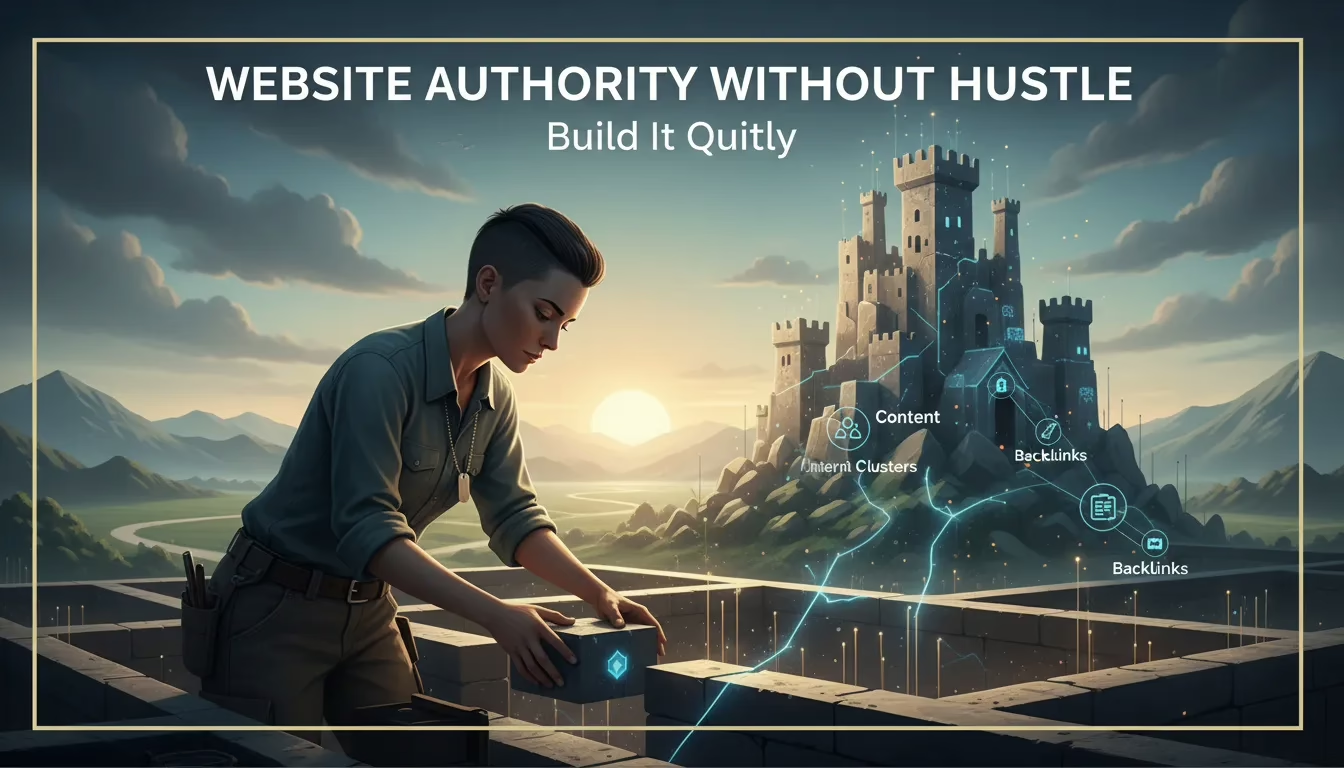
A few years ago, I tried the “more everything” plan: more posts, more platforms, more late nights. It worked… until it didn’t. I remember staring at my content calendar like it was an ops board gone sideways—color-coded, overstuffed, and somehow still not moving the mission forward. That’s when it clicked: online success isn’t a sprint powered by adrenaline; it’s a patrol schedule. Boring on purpose. Reliable. Repeatable. And weirdly, that’s where website authority starts to show up.
The Hustle Myth I Fell For (and Why It Backfired)
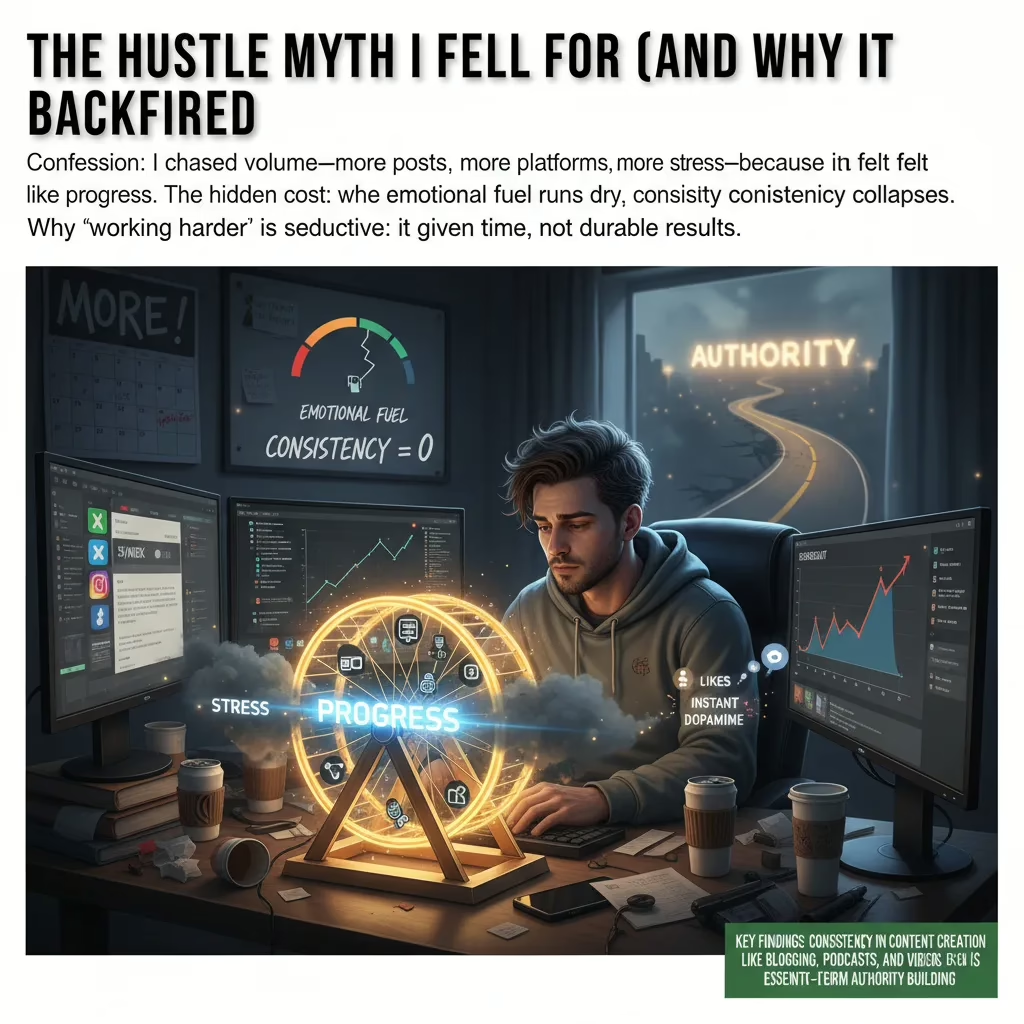
I’ll be honest: I fell hard for the hustle myth. Like most people aiming to build authority online, I believed success was a numbers game. More posts. More platforms. More stress. If I just worked harder, I thought, my online presence would explode. The dopamine hit from publishing something new or signing up for yet another social channel felt like progress. But it wasn’t sustainable—and it definitely wasn’t authority building.
My content calendar became a monster. I remember one week staring at a spreadsheet so packed with blog posts, videos, and podcast ideas that I needed three coffees just to face it. The irony? My coffee budget had a better ROI than my fourth social platform. I was everywhere, but my message was nowhere. The more I hustled, the less consistent I became. When my emotional fuel tank ran dry, so did my content marketing efforts. Consistency in content creation is essential for long-term authority building, but hustle relies on emotion—and emotion is unreliable.
Here’s the hidden cost: when you run on hustle, you’re running on fumes. The moment you hit burnout, everything collapses. I noticed a pattern: my best weeks weren’t the ones where I did the most. They were the weeks with the simplest plan—one clear message, one audience, and one repeatable system. That’s when my online presence actually grew.
Why is “working harder” so seductive? Because it feels good in the moment. It’s instant gratification. But it doesn’t create durable results. Authority building is different. It’s quiet. It’s repetitive. It’s about showing up with the same message, in the same lane, with the same process—day in and day out. As James Clear puts it:
“You do not rise to the level of your goals. You fall to the level of your systems.”
Authority doesn’t shout. It shows up daily. People trust what feels stable. From the outside, this kind of content marketing looks almost boring. But that’s the point. The real secret to building authority online isn’t hustle—it’s systems, consistency, and clarity. That’s what turns a fragile online presence into something that compounds quietly over time.
Authority Is Quiet: The Unsexy Advantage of Repetition
Authority doesn’t shout. It shows up daily. That’s the real secret behind building topical authority and trust online. I used to think I needed more—more posts, more platforms, more hustle. But the truth is, repetition isn’t laziness; it’s signal strength. For both humans and semantic search, showing up with the same message, in the same lane, with the same process is what wins.
Let’s break down what ‘quiet authority’ actually looks like:
-
Same message: I stick to my core idea. Every post, email, and update reinforces it.
-
Same lane: I don’t chase every trend. I focus on my audience’s main problem.
-
Same process: My workflow is a system, not a scramble.
My rule of thumb? If I can’t explain my positioning in one breath, I’m not positioned. This clarity is gold for semantic search and entity SEO in 2026. Search engines reward content clusters and structured data—meaning, the more consistently I show up around one topic, the more I’m seen as an authority. That’s topical authority in action.
Stability wins trust. People relax when they know what to expect from you. It’s like Seth Godin says:
“People do not buy goods and services. They buy relations, stories and magic.”
When I resist the urge to rebrand every month, I give my audience (and Google) something reliable. Here’s a practical example: I take one core idea—say, “quiet authority”—and turn it into a week of valuable content:
-
Monday: A story illustrating the idea
-
Wednesday: A how-to guide for implementing it
-
Friday: A Q&A or case study
No need to reinvent myself. I just deepen the conversation. That’s how semantic search recognizes my site as a hub for that topic. It’s not about intensity; it’s about consistency—especially when life gets noisy. Authority is built quietly, one steady step at a time.
The Authority Formula (One Audience, One Problem, One System, One Offer)
Building website authority without hustle starts with clarity, not chaos. Most people think more content, more platforms, and more hustle will bring inbound leads. But real authority is built quietly, through repetition, systems, and clear positioning. I learned this the hard way—by trying to be everywhere for everyone. It never worked. Authority compounds when you simplify. Here’s the formula that changed everything for me:
-
One audience
-
One problem
-
One repeatable system
-
One clear offer
Let’s break it down:
One Audience
I had to get honest about who I’m actually for—and who I’m not. When my message tried to please everyone, it wobbled. Now, I speak directly to my core audience. This focus sends strong relevance signals to search engines and makes my brand memorable. As Donald Miller says:
“If you confuse, you lose.”
One Problem
I stopped offering “general marketing help.” Instead, I chose a specific pain point I want to be known for solving. This clarity lets me target relevant keywords that match my audience’s real search intent. Every blog post, every headline, every resource is built around this one problem. That’s how authority building works—by being the go-to for something specific.
One Repeatable System
Hustle runs on emotion. Systems run on process. I built a content workflow I can run even on low-energy days. This means I show up consistently, which builds trust and keeps my inbound leads steady. My system is simple, repeatable, and doesn’t rely on willpower.
One Clear Offer
If people have to decode my bio to figure out how to work with me, I’ve failed. My offer is clear and visible. When someone asks, “How do I work with you?”—that’s my litmus test that the formula is working.
Why does this compound? Fewer decisions mean less chaos. Over time, my brand gets stronger mentions, better SEO, and more qualified inbound leads. Using relevant keywords and even structured data (for future-proofing) makes my content easier to find and trust. Authority isn’t loud—it’s inevitable when you follow this formula long enough.
Why Veterans Win Online (Even When They Don’t Feel “Creative”)
Most people think building an online presence is about hustle—more posts, more platforms, more stress. But real authority building doesn’t come from burning out. It comes from doing what veterans do best: trusting systems, not moods. Here’s why veterans have a natural edge when it comes to growth strategies online—even if they don’t see themselves as “creative.”
-
Veteran Advantage #1: SOPs—Content Doesn’t Need Inspiration, It Needs a Checklist
In the military, Standard Operating Procedures (SOPs) are everything. Online, it’s the same. You don’t need to wait for inspiration to strike. You need a repeatable checklist. That’s how you publish consistently, even on tough days. Authority is built by showing up, not showing off. -
Veteran Advantage #2: Chain of Command—Decisions Get Made Faster When Roles Are Clear (Even If It’s Just Me)
Veterans know who’s responsible for what. Even as a solo creator, I set clear roles for myself: strategist, writer, editor. No confusion, no wasted time. This clarity speeds up execution—one of the most overlooked growth strategies for building an online presence. -
Veteran Advantage #3: Process Over Emotion—Posting Isn’t a Mood; It’s the Mission
Hustle runs on emotion. But emotion is unreliable. I treat publishing like a mission, not a mood. As Jocko Willink says:“Discipline equals freedom.”
When you trust the process, you don’t get derailed by bad days. You keep moving forward.
-
Veteran Advantage #4: Long-Term Thinking—Authority Building Is a Slow, Predictable Win
Veterans play the long game. Authority online isn’t built overnight. It’s built by repeating the same message, in the same lane, over time. That’s how trust compounds—and why veterans win quietly, without hype.
Personal Story: I treated my weekly publishing like PT—non-negotiable, not dramatic. No one cheers you on for showing up, but over time, people notice your consistency. That’s when authority starts to grow.
Callout to Civilians: You don’t need a military background to win online. You just need a system you’ll actually follow. Borrow authority by collaborating, guesting on podcasts, and networking with others. These strategies accelerate credibility for anyone willing to show up with discipline.
Turning ‘Systems’ Into SEO: Content Clusters + Topic Clusters
Authority online isn’t built by hustling harder—it’s built by trusting systems. For me, content clusters and topic clusters are the SEO version of a well-run operation. Here’s my mental model: the pillar page is the mission brief, setting the objective and scope. Each supporting post is like a patrol report, diving deep into a subtopic, always linking back to the main mission. This structure doesn’t just help readers; it signals topical authority to Google’s semantic search, which now cares about entities and related concepts as much as keywords.
I start by identifying one core problem my audience faces. Around that, I build a content cluster—usually 6 to 12 subtopics that answer the same customer question from different angles. For example, if my pillar is “How Veterans Build Online Authority,” my subtopics might include SOPs for content, internal linking strategies, and the role of educational blogs in trust-building. Each piece is interlinked, like a well-marked base: no dead ends, every page points somewhere useful.
-
Pillar page = mission brief: Sets the objective, covers the big picture.
-
Supporting posts = patrol reports: Dive into subtopics, always link back to the pillar.
-
Internal linking: Every page is a checkpoint. If a reader lands anywhere, they can navigate to the next logical step.
-
Quick win: Add a “Start Here” hub page. This routes visitors to your best educational blogs and pillar content, boosting both user experience and SEO.
When I’m tempted to chase trends or random topics, I drop them in a “later” doc. I return to the cluster—because repetition and consistency build authority, not scattered effort. As Ann Handley says,
“Good content isn’t about good storytelling. It’s about telling a true story well.”
Over time, this system compounds. Internal linking from high-authority pages lifts the ranking potential of newer content. Educational blogs and value-driven videos position me as a reliable resource. That’s how topical authority grows—quietly, with every interlinked post reinforcing the mission. Authority isn’t loud; it’s inevitable when you build with clusters and systems.

Keyword Research Without the Spiral (Relevant Keywords, Not Rabbit Holes)
Keyword Research: My 30-Minute System
Keyword research doesn’t have to eat your week—or your sanity. I set a timer for 30 minutes, and that’s it. No endless scrolling through keyword tools or chasing the latest “secret” phrase. Authority is built on systems, not hustle. I trust my process, and I stick to it. This small boundary keeps me focused and prevents burnout.
Start With Real Client Language
Before I even open a tool like SEMrush, I dig into the language my audience actually uses. I scan emails, DMs, and call notes. What words do real people use when they describe their problems? That’s where the most relevant keywords live. As Rand Fishkin says,
“The best marketers are empathetic—they understand the audience better than the algorithms.”
When you start with empathy, you avoid sounding like a robot—and you connect with the people who matter.
One Primary Keyword, Natural Support
Each piece of content gets one ‘primary’ keyword—aligned with my clear positioning and the single problem I solve. I sprinkle in supportive phrases naturally, using the same words my clients use in conversation. This signals authority to search engines and builds trust with readers. No keyword stuffing, no awkward phrasing—just valuable content that answers real questions.
Match Search Intent: Teach, Compare, or Sell?
Not every keyword belongs on the same page. I ask myself: Am I teaching, comparing, or selling? Each intent deserves its own space. Teaching keywords get guides and how-tos. Comparison keywords get reviews or side-by-sides. Selling keywords get offer pages. This keeps my site organized and my authority clear.
Small Habits, Big Impact
-
I keep a running “question bank”—a simple doc where I drop every client question or phrase that pops up. This becomes a goldmine for future valuable content and relevant keywords.
-
If a keyword makes me sound like a stranger to my audience, I skip it. Authority is quiet, not desperate. If it doesn’t fit my voice or my system, it’s out.
Keyword research, done right, is about consistency and empathy—not chasing trends. It’s a system, not a sprint. That’s how you build authority quietly, one relevant keyword at a time.
Off-Page, But Not Off-Mission: Quality Backlinks + Brand Mentions
Quality Backlinks: Trust Transfers, Not Trophies
Here’s my reframe: backlinks aren’t trophies—they’re trust transfers. I don’t chase links for vanity. I earn them by creating content that others genuinely want to reference. Brian Dean said it best:
“Link building is like voting—if you want votes, you need something worth voting for.”
That means original research, comprehensive guides, and frameworks that actually help people. When I publish a data-driven study or a step-by-step guide, I’m not just filling space—I’m giving my industry something to cite. High-quality backlinks from this kind of valuable content don’t just boost my search visibility—they compound my authority over time.
Here’s a simple outreach script I’d actually use (no cringe, no spam):
 Hi [Name],
I noticed your recent post on [topic]—great insights. I just published some original research on [related topic] that might add value to your readers. If it’s helpful, feel free to reference it.
All the best,
[Your Name]
No pressure, no awkward asks. Just offering real value.
Brand Mentions: Authority Without the Link
Brand mentions matter—even when there’s no hyperlink. When people talk about your work in podcasts, newsletters, or social posts, it signals to search engines (and AI) that you’re a trusted resource. People talk about what helped them. Every mention is a digital breadcrumb, reinforcing my authority and expanding my reach.
Industry Relationships: Show Up in Other People’s Rooms
Off-page SEO isn’t just about links. It’s about showing up in other people’s rooms—guesting on podcasts, contributing to newsletters, collaborating on original research, or partnering with influencers who share my values. These relationships are built on trust, not transactions. I keep it ethical: no spammy link swaps, no shortcuts. I’m here for the long game.
-
Publish original research and guides for natural backlinks
-
Value brand mentions as authority signals—even without links
-
Build industry relationships through authentic collaboration
-
Keep outreach simple, helpful, and human
If my income needs hype, it’s fragile. If it runs on systems, it compounds. Off-page SEO is quiet, but it’s never off-mission.
The ‘Authority Stack’ I’d Build If I Started Over (A Hypothetical Scenario)
If I had to start from scratch—just 90 days, a tiny audience, and zero interest in dancing on camera—here’s the high authority stack I’d quietly build. No hustle, no hype. Just steady, structured moves designed for inbound leads and long-term trust.
Weeks 1–2: One Audience, One Problem, One Offer
First, I’d get crystal clear on who I’m helping and what I solve. I’d write a simple, direct offer page—no fluff, just clarity. As Cal Newport says,
“Clarity about what matters provides clarity about what does not.”
This is the foundation. Authority starts with positioning, not noise.
Weeks 3–6: Build a Content Cluster
Next, I’d create one in-depth pillar guide—the kind of resource people bookmark and share. Around it, I’d publish six supporting posts, forming a tight content cluster. Each post would answer a related question or break down a subtopic, all internally linked. This isn’t about volume; it’s about repetition and consistency. Structured data would be set up as basic hygiene—helping search engines trust and understand my site, not as a magic bullet.
Weeks 7–10: Proof, Links, and Trust Signals
-
Internal Linking: I’d strengthen connections between posts for seamless navigation and SEO.
-
Proof Pages: Drawing from agent authority stacks, I’d add testimonials, case studies, or “as seen in” logos—whatever proof I could gather. For local businesses, I’d consider hyperlocal insights, but only if relevant.
-
Structured Data: I’d double-check the basics—review schema, article markup, and organization details.
Weeks 11–13: Borrow Authority & Attract Inbound Leads
Finally, I’d reach out for two collaborations—maybe a podcast guest spot or a co-authored article. Borrowing authority from others accelerates credibility, especially for new sites. I’d aim for a couple of quality backlinks, not quantity.
The point? This isn’t about going viral. It’s about building high authority that compounds quietly. Not loud, but stable. Not scattered, but focused. Over time, this stack attracts inbound leads and trust—without the burnout of endless hustle.

Conclusion: I Don’t Want ‘Hype Income’—I Want Compounding Authority
After years of watching the online world chase the next big thing, I’ve realized something simple but powerful: hustle is loud, fragile, and emotional. It’s easy to get caught up in the noise—posting more, chasing more platforms, and burning out in the process. But real authority building doesn’t come from hype. It comes from quiet, steady systems that work in the background, compounding over time.
Here’s my promise: I’m choosing boring consistency over performative intensity. I’m not interested in being the loudest voice or the flashiest brand. I want to build website authority that lasts—authority that grows quietly, day after day, through repetition, clear positioning, and a repeatable process. I want my online presence to be like a well-run supply line: unseen when it’s working, but absolutely essential. You don’t notice it until it’s missing, and by then, it’s already too late.
For veterans—and anyone who’s learned discipline—the good news is you already have the mindset. You know that missions aren’t won by winging it, but by trusting systems and showing up, even when it’s not exciting. Civilians might have to learn this, but for us, it’s second nature. Authority is built the same way: with standard operating procedures, chain of command, and long-term thinking. Consistency in content creation—whether it’s blogging, podcasts, or videos—isn’t glamorous, but it’s the foundation of lasting authority.
Simon Sinek said it best:
“Working hard for something we don’t care about is called stress; working hard for something we love is called passion.”
I’m passionate about building something that lasts, not something that just looks good for a moment. If your income needs hype, it’s fragile. If it runs on systems, it compounds. That’s the difference between chasing trends and building real authority.
So, here’s my invitation: follow the journey. Subscribe. Let’s build something that lasts together. Because authority isn’t loud; it’s inevitable.
TL;DR: Hustle runs on emotion; authority runs on systems. Pick one audience, one problem, one repeatable content system, and one clear offer. Use SEO basics (keyword research, content clusters, internal linking, quality backlinks, brand mentions) and execute consistently quiet authority compounds into inbound leads.