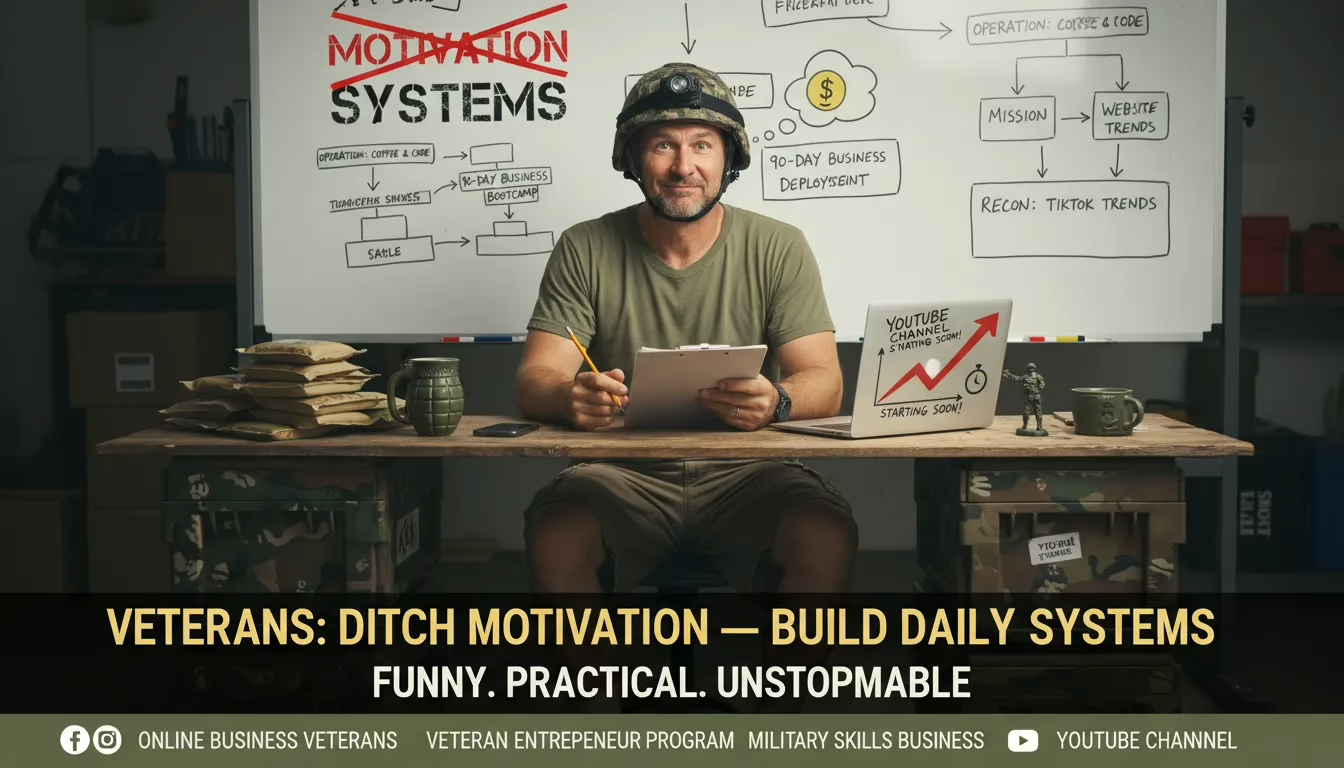
I served, I followed SOPs, and yes — I once fixed a generator at 0300 with duct tape and a prayer. So when my attempt to launch an online course fizzled, I realized it wasn’t laziness. It was the absence of a system. This post is my half-sincere, half-military briefing on why veterans thrive when they swap motivation for repeatable systems.
1) The Problem: Hustle Fatigue vs. System Fatigue
Find Your Mission (Because “Try Harder” Isn’t a Plan)
I thought I needed more grit. Turns out I needed a map. Hustle without a system feels like running laps with no finish line—sweaty, proud, and somehow still lost.
Most Online Business Veterans fall into the same trap: we take the one tool that always worked in the military—do more—and we apply it to the internet. So we post more, learn more, buy more courses, and “network” more. Congrats, you just multiplied noise, not results.
Hustle Fatigue: When Effort Scatters
Hustle fatigue is what happens when you’re working hard with no clear target. You’re busy, but nothing compounds. It’s like doing PT with no training plan: you’ll be tired… and still not pass the test you actually care about.
System Fatigue: When the System Is Missing
Here’s the twist: veterans don’t lack discipline. We have it in bulk. We follow SOPs. We execute under pressure. We adapt in chaos. But without systems in business, that discipline gets misapplied—like doing a perfect room-clearing drill in the wrong building.
Jonathan Montoya: “Search engine strategy is the compass — without it, content is just noise.”
Quick Example: Random Posting vs. Keyword-driven traffic strategy
I spent months posting “whatever felt right.” Motivational clips. Coffee thoughts. A random rant about funnels. Six months later? I had engagement… from my mom and one guy trying to sell me crypto.
Then I switched to a Keyword-driven traffic strategy and a simple content calendar. Same effort—way better results. That’s the difference between vibes and Marketing Strategies.
Actionable Takeaway: System-First, Not Effort-First
-
Positioning: Who do you help, and with what problem?
-
Clear marketing message: Say the same thing, the same way, repeatedly.
-
Structured execution: Use a plan (even a simple Freedom_Accelerator_Module_6-min-style checklist) for YouTube or content.
Also, confession: I once scheduled a livestream for 0500 because it “felt authentic.” Nobody showed up. Not even me. Systems > vibes—run the system for 90 days and let consistency do the heavy lifting.
2) Authority Isn’t Followers — It’s Predictability
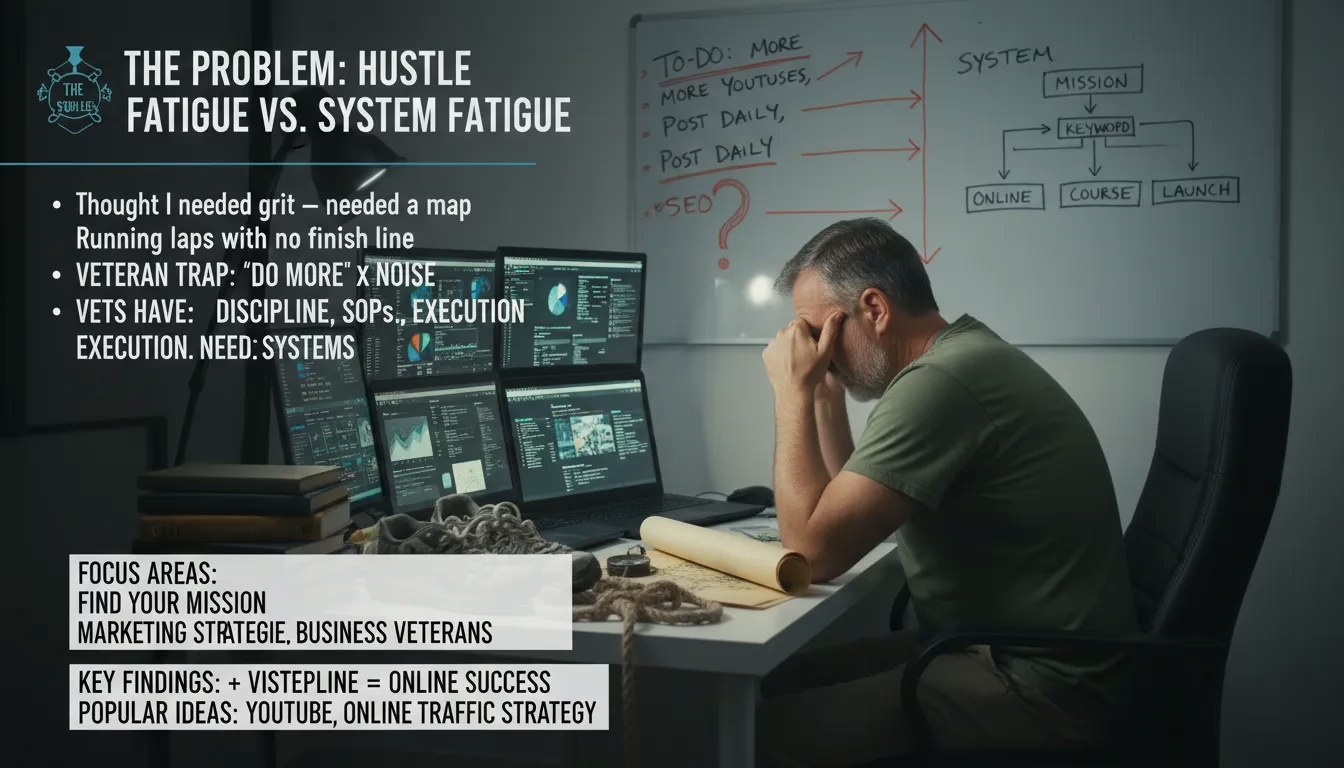
I used to count followers like they were points on a PT test. “Look at me, I got 12 new followers—promote ahead of peers!” Then I realized something painful: followers are a vanity metric. Authority is when people can predict you’ll show up—and they plan their week around it.
Rachel Turner, Veteran Entrepreneur Coach: “Predictability beats hype — and veterans already have the muscle for it.”
For Veteran Entrepreneurs, Authority = Reps on a Schedule
In the military, drills weren’t exciting. They were effective. Same thing here: repetition under structure builds authority and trust. If you publish daily (or at least 3x/week), you become known → trusted → paid. Not because you’re loud, but because you’re consistent.
Pick One Clear Problem (Per Audience Segment)
If your YouTube Channel is “business, mindset, fitness, coffee reviews, and leadership,” nobody knows why to subscribe. Choose one problem your people want solved. Example: “Help veterans build simple Online Courses from their experience.” That’s a lane.
My Micro-Habit Content Pipeline (Boring, Reliable, Profitable)
Here’s the tiny system that keeps me moving even when motivation is on leave:
-
20 minutes writing (one tip, one story, one takeaway)
-
15 minutes keyword research (so the internet can actually find it)
That’s 35 minutes. Not heroic. Just repeatable. Put it on an editorial calendar anchored to keywords, and you’ve got a content machine.
Same Message, Different Formats
Consistent publishing leads to compounding returns when you recycle the core idea:
-
One topic becomes a YouTube Channel video
-
The script becomes a blog post
-
The key steps become an email
-
The full process becomes Online Courses (yes, that’s how it happens)
-
Bonus: record it as a podcast while driving to Costco
Funny aside: once I got predictable, my grandma started trusting my advice—and she used to ignore everything I said unless it involved taking out the trash.
Track Quality Signals (Not Ego Signals)
-
Audience retention (are they staying?)
-
Repeat visits (are they coming back?)
-
Messages like “I tried this” (proof you’re leading)
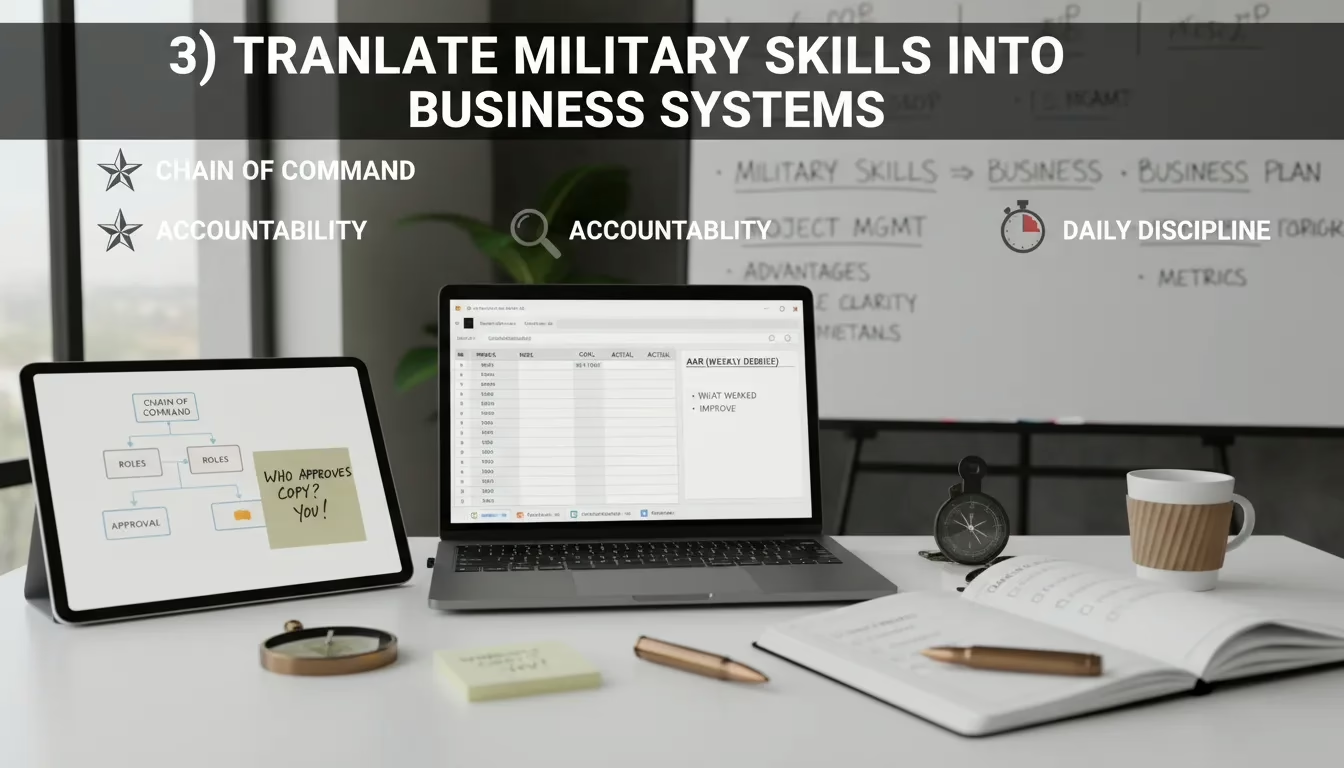
3) Translate Military Skills into Business Systems
When people say Leverage Military Skills in business, they usually mean “put ‘veteran’ in your bio and hope money falls from the sky.” I tried that. Spoiler: the sky stayed broke. What worked was translating what I already knew into a simple operating system.
Chain of Command = Clear Roles (Even If It’s Just Me)
In a one-person business, chain of command still matters. Who writes the copy? Me. Who approves it? Also me. But I don’t let “Private Me” argue with “Commander Me” for three hours. Commander sets the objective, Private executes. That’s basic Project Management Skills with a haircut.
Mission = Offer (Yes, This Made My Sales Page 17% Clearer)
I started framing my offer like a mission brief: objective, target, constraints, success criteria. The result: my sales page felt 17% clearer to me (and 83% less painful to write). That clarity is basically Business Plan Development without the 40-page Word doc nobody reads.
Explicit mapping:Mission = OfferLogistics = FunnelIntel = DataExecution = Daily sprint
Logistics = Funnel (Map the Customer Journey End-to-End)
Logistics brain says: “How does this move from Point A to Point B without breaking?” Your funnel is the same. Traffic → content → email/DM → call → sale → onboarding. If any link is missing, your “supply chain” collapses and you blame motivation. (Ask me how I know.)
Intel = Data (Simple KPIs Only)
-
Keywords ranked (SEO traction)
-
Watch time (YouTube signal)
-
Lead form fills (demand)
Jonathan Montoya: “Treat your launch like an op order — clear objective, tasks, and metrics.”
Accountability = Weekly AARs (After My Failed Launches)
Every week I run an AAR: what worked, what didn’t, what I’ll change. No drama. Just reps. Military-friendly programs like Boots to Business and EBV help bridge gaps fast, especially when you’re turning Military Skills Business experience into real systems.
Execution = Daily Sprint Checklist
-
Publish: 1 short post or video
-
Outreach: 5 helpful DMs/comments
-
Optimize: update 1 title/keyword
-
Review: log KPIs in 5 minutes
4) The Marketing Mess: Positioning, Messaging, and Keywords
Positioning (Parking Spot) + Messaging (The Sign)
Most Marketing Strategies fail because we “park” our business in the wrong spot. Positioning is the parking space. Messaging is the sign on the storefront. If I park at “Everyone Welcome,” I’ll sell to… nobody. If I park at “Veterans building online income,” now the right people walk in.
My simple rule: your marketing message must say who you serve, what problem you solve, and what the offer is—in one breath. If it takes longer than a chow line story, it’s leaking conversions.
Keyword-driven traffic strategy: Stop Shooting in the Dark
Discoverability isn’t luck. It’s search intent. A Keyword-driven traffic strategy means you publish what people are already typing into Google and YouTube. Jonathan Montoya nailed it:
Jonathan Montoya: “If you’re not thinking in keywords, you’re missing the people already searching for you.”
Translation: stop posting “motivational” stuff and start posting “findable” stuff. Messaging converts, but keywords bring the right eyeballs so your funnel doesn’t feel like a bucket with holes.
Structured YouTube execution plan for your YouTube Channel
On my YouTube Channel, I don’t wait for inspiration. I run a mini SOP (Freedom_Accelerator_Module_6-min style): topic clusters, quick script, clear CTA, then repurpose.
|
1 Long Video |
Repurpose Rate |
|---|---|
|
8–12 minutes |
3 short clips + 2 social posts |
Content pillars tie it together: how-to, case study, testimonial. Same mission, different angles.
Practical step: 10 keywords → 90-day calendar
Use simple tools: Google Keyword Planner, YouTube Analytics, and a basic browser extension for keyword ideas. Pick 10 high-intent keywords and rinse-repeat for 90 days:
-
veteran online business system
-
daily systems for entrepreneurs
-
email list for beginners
-
how to start affiliate marketing
-
keyword research for YouTube
-
YouTube SEO for beginners
-
content calendar for YouTube
-
marketing message examples
-
positioning statement template
-
lead magnet ideas
My goofy test? I titled a video: How a Vet Fixed My Wi-Fi (And Built an Email List)—and yes, people clicked. Humans are weird. Systems win.
5) Programs & Resources — Where to Get Help (and Free Stuff)
I love “motivation” as much as I loved surprise room inspections. So instead, here’s the cheat code: plug into a Veteran Entrepreneur Program that already has the lanes painted, then run your own 90-day system beside it.
Boots to Business (SBA/DoD TAP) — the no-cost primer
Boots to Business is part of TAP and has trained 50,000+ service members and spouses. It’s a solid “business 101” without the tuition bill. The SBA even brags (politely):
SBA Program Lead (Boots to Business): “Transition training scaled — we’ve helped tens of thousands find entrepreneurial footing.”
Source: U.S. Small Business Administration (SBA) — https://www.sba.gov/
Entrepreneurship Bootcamp for Veterans (EBV) — phased training that feels like an SOP
The Entrepreneurship Bootcamp for Veterans (EBV) is practical and phased: online learning plus an in-person residency style component (varies by school). If you want structure, this is structure.
Source: EBV Consortium — https://ebvfoundation.org/
VETRN — free 12-week course + peer mentoring
VETRN is a free 12-week online entrepreneurship program with peer mentoring. Translation: you get accountability without paying “guru tax.”
Source: VETRN — https://www.vetrn.org/
Warrior Rising Program — extra support for service-disabled vets
Warrior Rising offers free courses and help building a business plan. If you qualify, use it—because free tuition options are my favorite kind of freedom.
Source: Warrior Rising — https://www.warriorrising.org/
Texas Veteran Entrepreneur Program — regional, but legit
The Texas Veteran Entrepreneur Program can help with consultations, business plans, and contracting guidance. Even if you’re not in Texas, it’s a good model for what your state may offer.
Source: Texas Veterans Commission — https://www.tvc.texas.gov/
Pro tip: pair training + a 90-day system
-
Pick one formal track (EBV or VETRN) and treat sessions like milestones.
-
Match the program to your idea: e-commerce needs ops + ads; consulting needs positioning + content.
-
Run a simple 90-day checklist:
publish,pitch,improve, repeat.
6) The 90-Day System: A Pilot You Can Actually Finish
Here’s the deal: I’m not asking you to “believe in yourself” like a Disney side character. I’m asking you to run a 90-day experiment. Not forever. Not “until it feels right.” Just 90 days of executing one system like it’s your job—because it is.
Rachel Turner, Veteran Entrepreneur Coach: “Ninety days of disciplined systems is worth a year of scattered hustle.”
Step 1 Mission (Week 1): Pick the Target
Week 1 is for clarity, not content chaos. Use this Step 1 Mission checklist and stop “helping everyone” (that’s how you help no one).
-
Audience: Who do I serve?
-
Problem: What pain do they want solved?
-
Offer: What do I sell to fix it?
-
Message: One sentence I can repeat without improvising.
Phase 1 Course (Weeks 2–6): Build the Content Engine
This is where you install the machine. Think Phase 1 Course work: learn the basics, then execute the basics. A 12-week structure like VETRN (84 days) works because it forces focus—no endless “trying,” just a clear window to decide what’s working.
Build a simple YouTube skeleton: 3–5 repeatable video topics, one keyword theme, one call-to-action. Boring is good. Boring scales.
Phase 2 Residency (Weeks 7–12): Intel, Outreach, AAR
Now we go operational. Phase 2 Residency is where peer mentoring matters—someone else sees your blind spots before you marry them. Each week, run an after-action review and adjust the message, not your sleep schedule.
Daily Sprint Checklist (Do This, Then Go Live Your Life)
-
Create 1 valuable asset (post, video, email)
-
Optimize 1 keyword (title, description, page)
-
Review metrics (watch time, rankings, leads)
-
Outreach 1 prospect or partner
|
KPI |
90-Day Example Target |
|---|---|
|
Watch time |
1,000 minutes |
|
Lead submissions |
50 |
|
Sales |
5 |
If the numbers are flat after honest AARs, you don’t need more motivation. You need a tighter mission and cleaner messaging. Mission over motivation.
7) Wild Cards: Hypotheticals, Analogies, and My Weird Tests
Hypothetical: Battalion-Run Instagram
If a battalion ran Instagram like a logistics op, would we win market share in the Digital Marketplace? Probably, yes. We’d have a posting SOP, a content convoy schedule, and a “no random memes without a purpose” policy. Every post would support the mission: one problem, one audience, one clear offer. Boring? Maybe. Effective? Absolutely.
Analogy: Funnels = Supply Lines
Your funnel is like supply lines. Choke points kill operations and conversions. If your landing page is slow, your email follow-up is missing, or your CTA is vague, that’s the marketing version of “we ran out of fuel 3 miles from the objective.” Want Scalability Digital Business growth? Fix the choke point before you “push more traffic.”
Jonathan Montoya: “Treat experiments like recon — collect intel, don’t fall in love with the result.”
My Weird Test: Free 10-Minute AARs
I offered free 10-minute AARs to ten prospects. No pitchy weirdness—just: “Show me your page, I’ll tell you what’s broken.” Three paid within a month. That’s 30% from a tiny recon-style test, and it taught me what message actually landed.
Copy/Paste Mini-Experiment
-
DM 10 people:
Want a free 10-min AAR on your funnel? I’ll give 3 fixes. -
Deliver fast, specific feedback.
-
Offer next step:
If you want help implementing, I can do it with you.
Creative Exercise: One-Sentence Mission + Brutal Feedback
Write your mission in one sentence, then text it to a buddy for ruthless Peer-to-Peer Mentoring feedback. Use this template:
I help [who] get [result] using [system] without [pain].
Mini-Case: 90-Day Publishing Sprint
One vet in my circle ran a 90-day YouTube publishing sprint—same topic, same promise, no wandering. He doubled email signups. Not magic. Repetition under structure.
Aside: Automation Humility
I once tried to automate gratitude emails and accidentally sent “Thanks, SIR” to my mom’s book club. So yes—systems work. Just… proofread the automation.
8) Conclusion & Call to Action — Mission Over Motivation
Here’s the wrap-up: motivation is the spark, but systems are the engine. And veterans? We already have the fuel. If you can follow an SOP at 0400 with zero caffeine and a bad attitude, you can Start Online Business tasks with a simple daily sprint. The problem was never your work ethic—it was trying to build authority on vibes and “I’ll do it tomorrow” energy.
For the record, I love Veterans Online Tips, but the best tip is boring: do the same right things long enough for the internet to notice. A focused system plus veteran habits accelerates traction, and that’s not just me talking.
Rachel Turner, Veteran Entrepreneur Coach: “When veterans apply their operational habits to business, success is often a matter of consistency.”
Your 90-Day “Mission Over Motivation” Starter Plan
-
Define the mission: one offer, one audience, one problem you solve.
-
Pick 10 keywords: the exact phrases your people search (yes, write them down).
-
Commit 90 days: same publishing cadence, same message, measurable metrics.
-
Run weekly AARs: what worked, what didn’t, what gets adjusted next week.
If you want my exact operational blueprint, comment SYSTEM on today’s post. Yes, I read them all. If you’d rather skip the guesswork, join the next training. And if you want extra support, community programs and bootcamps pair perfectly with your self-driven 90-day experiment—especially if you’re building Veteran-Owned Businesses and want accountability that doesn’t feel like babysitting.
Next-Step Resources
-
Warrior Rising
-
Texas Veteran Entrepreneur Program
You don’t need permission—you need a plan. And a coffee mug that says “Mission Over Motivation.” Mission accepted? Good. Now schedule your first daily sprint… I’m scheduling mine right after I find my keys (again).
TL;DR: Stop chasing motivation. Define your mission, build a 90-day system (content + traffic + execution), use military habits (AARs, chain of command) and leverage veteran programs to scale.
Leave a Reply
You must be logged in to post a comment.