
I still remember 0430 cold and dark, boots laced and not a single person asked how I felt. We operated on orders and systems. Years later, I chased business ideas waiting for a mood I never found. In this post I reclaim that training: motivation is fleeting; systems endure. I write in first person because this is how I rebuilt income—by wiring processes that run whether I’m energized or exhausted.
Why Motivation Fails Veterans (and What I Learned)
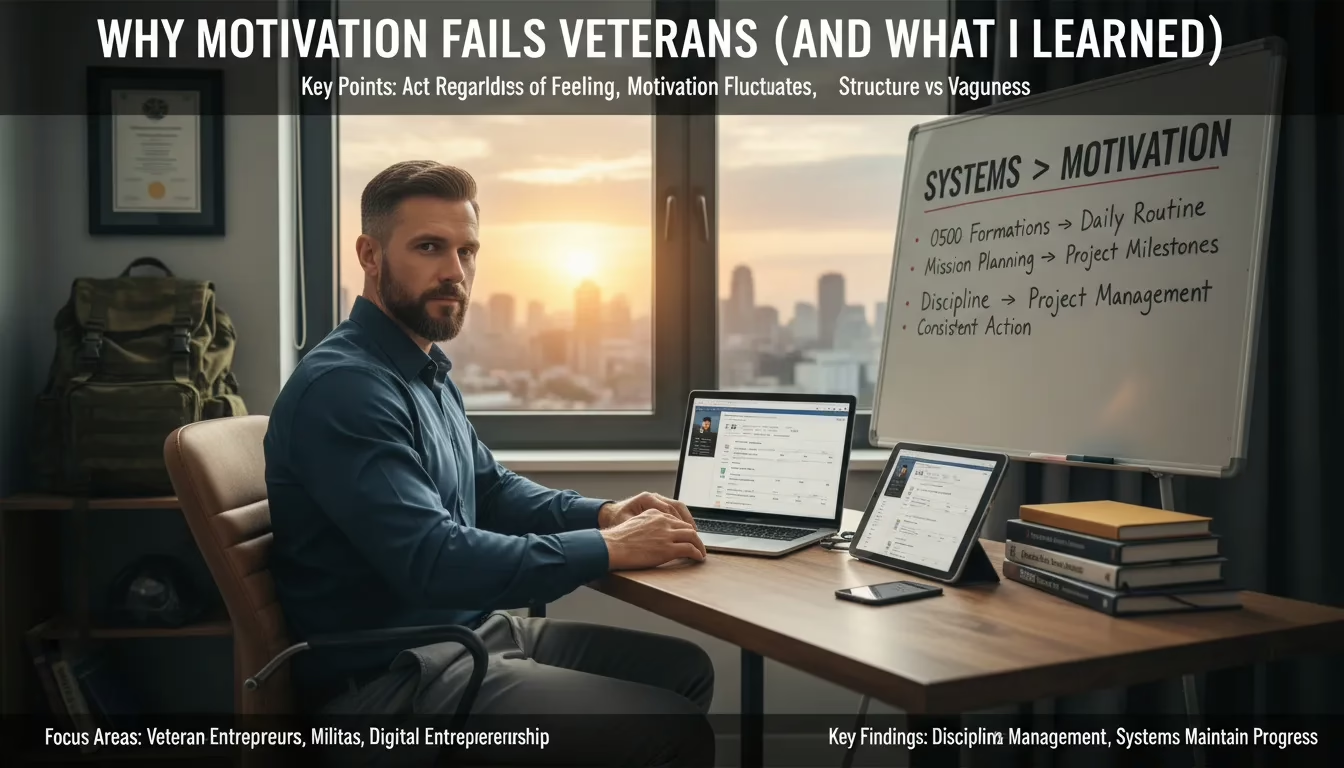
I was trained to act no matter how I felt. A 0500 formation didn’t care if I slept two hours, had stress at home, or felt “inspired.” I showed up because the system demanded it. That’s one of the most overlooked Military Skills for Veteran Entrepreneurs: disciplined execution.
Motivation Is Emotional, and Emotions Change
In civilian life, I kept hearing, “Just stay motivated” and “Find your why.” But motivation rises and falls with sleep, stress, money pressure, and real life. Some days my head was clear. Other days my energy tanked, and my mood followed. I’ve also seen how mental health realities can make “push harder” feel like a bad joke. Motivation is unreliable because it’s tied to feelings—and feelings are not predictable.
How Motivation Sabotaged My First Digital Entrepreneurship Launches
When I started in Digital Entrepreneurship, I treated motivation like fuel. If I felt good, I posted. If I felt unsure, I waited. That turned into missed deadlines, half-finished funnels, and “launches” that were really just bursts of effort followed by silence. I wasn’t failing because I lacked talent. I was failing because I built a business that only worked on good days.
What Actually Kept Me Moving (In Uniform and After)
During deployments, I didn’t rely on hype. I relied on checklists, timelines, and clear roles. That same structure saved me later during slow seasons in business. The leadership and project management parts of my training translated directly: define the mission, break it into steps, and execute the next step even when I’m tired.
Colonel Mark Reynolds, Veteran Entrepreneur: “Discipline beats inspiration—every single time I needed to rebuild, systems saved me.”
Systems I Trust More Than Mood
-
Content scheduled ahead of time
-
Lead capture that runs automatically
-
Follow-ups handled with templates or AI
-
One repeatable daily action I can do on low-energy days
Veterans own over 1.6 million businesses employing 3.3 million Americans, and programs like VETRN MBA have helped over 2,500 veteran business owners grow. The pattern is simple: systems are predictable; feelings are not. Build the former.
The Civilian Trap: Waiting to Feel Ready
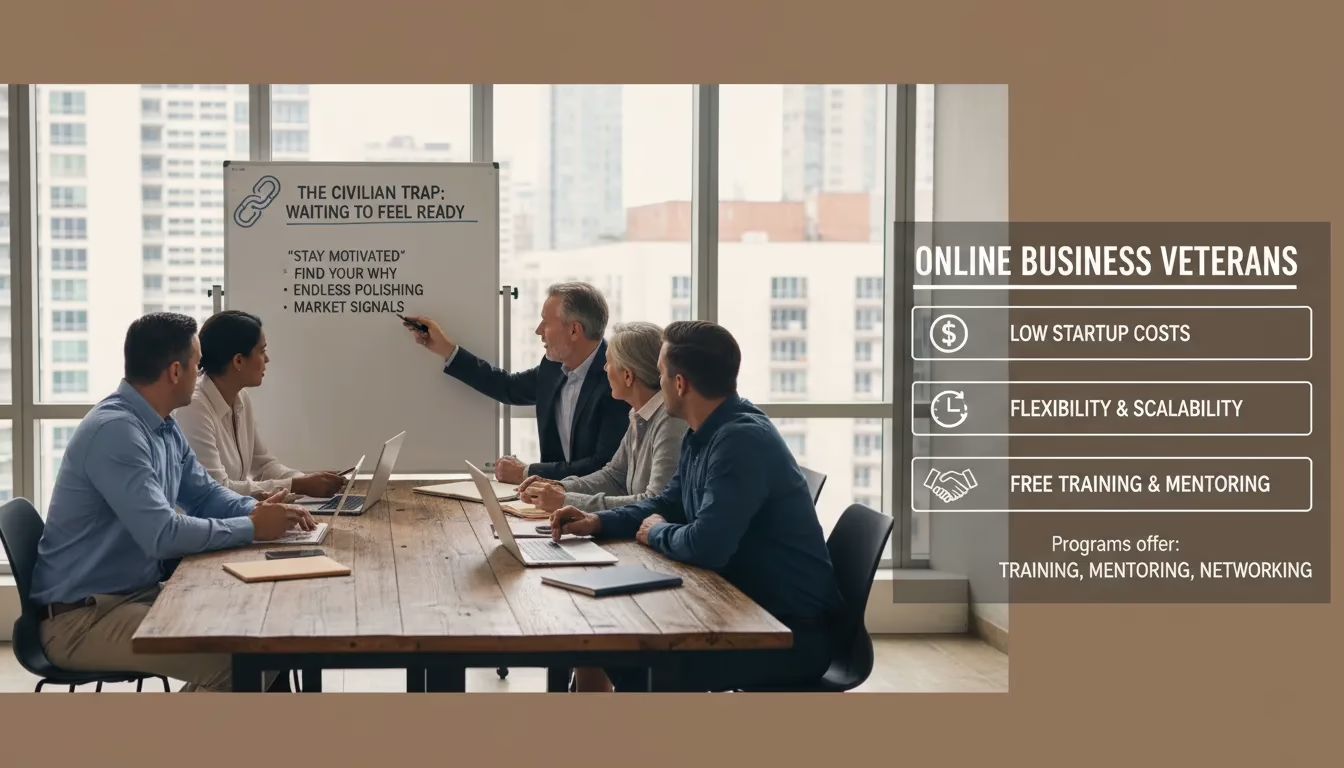
I see it all the time with Online Business Veterans: we leave a world where the schedule runs us, and we step into a world that tells us to run on feelings. Suddenly the advice is, “Just stay motivated” and “Find your why.” That sounds nice, but it can stall a disciplined person fast.
In uniform, nobody asked if I felt inspired before a 0500 formation. The system was the system. Civilian life flips that script. If I don’t build the process, nothing moves. And that’s where the trap shows up: civilians often wait for the perfect window, the perfect mood, the perfect sign.
Benefits Online Businesses: Flexibility Online Businesses + Startup Costs
Online businesses are built for veterans who want control again. The Startup Costs can be low compared to a storefront, and the Flexibility Online Businesses offer is real—work around appointments, family, or a day when your energy is off. They also scale: one good system can reach more people without doubling your hours.
How the Trap Looks in Real Life
-
Polishing a logo and website for weeks instead of talking to customers
-
Waiting for “market signals” to line up perfectly (they never do)
-
Buying more courses to feel prepared, but never shipping anything
I did it too. I delayed my first offer launch for two months because I was “waiting for inspiration.” I kept tweaking the plan, telling myself I was being smart. What I really did was lose momentum—and confidence—one quiet day at a time.
Dr. Emily Chen, Small Business Mentor: “Waiting for motivation is a luxury most entrepreneurs can’t afford—systems are the equalizer.”
My Minimum Viable Routine (Runs on Low-Energy Days)
-
One daily action: post, pitch, or follow up—no exceptions
-
One simple system: schedule content ahead and capture leads automatically
-
One support lane: use free veteran training, mentoring, and networking (and GI Bill options) to stay accountable
I don’t need to feel ready. I need a routine I can execute when I’m tired. Small experiments beat perfect plans—every time.
The System Shift: From Mood to Mechanism
I used to ask, “How do I stay motivated?” Then I noticed the pattern: motivation showed up when life was easy and disappeared when it mattered most. So I made The System Shift. I started asking, “What runs even when I’m tired?”
In Project Management terms, a system is simple: repeatable, measurable, and minimally emotional. It doesn’t care if I’m in a great mood or a rough one. It just executes—like the military taught me. That discipline maps cleanly to systems thinking: build the mechanism, then let it carry the load.
Strategic Planning: My Three-System Framework
-
Content System: I batch ideas, write in blocks, and schedule posts ahead. One setup, many outputs.
-
Lead Flow System: I use automated lead capture (a simple form + email sequence) so leads come in consistently, not randomly.
-
Fulfillment System: I deliver the same way every time—checklists, templates, and clear steps—so quality stays high even on bad days.
Business Growth Runs on Leverage, Not Hustle
This isn’t hustle culture. Hustle says “push harder.” Systems say “set it once, get paid many times.” When motivation drops, systems still execute. When systems execute, progress still compounds. That’s how Business Growth becomes predictable instead of emotional.
Lt. Col. Sarah Hayes, Founder of Veteran Business Lab: “A 30-minute nightly system beats a sporadic 8-hour grind—every single time.”
One Repeatable Daily Action Compounds
My smallest win is also my most powerful: one daily action I can do no matter what. Over weeks and months, that steady output builds trust, traffic, and income. Automated lead capture also increases conversion consistency because the follow-up happens even when I’m offline.
Practical Tip: 30 Minutes Nightly
-
Queue tomorrow’s content (1 post + 1 email).
-
Schedule it.
-
Check your lead form and automation.
30 minutes nightly → queued content → consistent leads → steady fulfillment
Concrete Systems That Run on Bad Days
When my mood drops, I don’t “push harder.” I lean on Marketing Sales Strategies that are already built. Bad days still happen. The difference is my business doesn’t stop when I’m tired.
Schedule Content Like a Mission Plan
I batch write and record in one block, then schedule weeks ahead. That means my social posts and blog pieces publish even when life hits.
-
Batch 5–10 posts in one sitting
-
Schedule with Buffer, Hootsuite, or Meta Planner
-
Store drafts in Google Docs with a simple naming rule
Lead Capture That Works While I Sleep
I set up one opt-in page and one email sequence. That’s how I Build Grow Business without chasing people.
-
Email tools: ConvertKit, Mailchimp, or ActiveCampaign
-
Opt-in: a checklist, short guide, or “quick start” video
-
Automation: 5–7 emails that teach, then offer a next step
Follow-Ups: AI + Templates (My Lost-Lead Win)
I used to lose leads because I’d “get to it later.” One week, I automated follow-ups with a simple AI assistant and three templates. Two old prospects replied within 48 hours, and one turned into a paid call. That system paid for itself fast.
Options: a basic CRM reminder, a VA using scripts, or AI-drafted check-ins you approve.
My 20–30 Minute Ritual: “The Daily Forward”
-
Send 3 follow-ups
-
Post 1 helpful insight
-
Improve 1 asset (landing page, email, offer)
Monetization Touchpoints That Don’t Need Constant Energy
-
Evergreen offer (recorded workshop)
-
Subscription (monthly templates or coaching)
-
Low-touch consulting (fixed-scope audits)
SOPs: Turn Military Orders Into Business Tasks
I document steps so someone else can run them when I can’t.
SOP: New lead → tag → email sequence → follow-up day 3 → book call link
Rachel Ortiz, CEO, Bunker Labs Chapter: “Systems allow veterans to scale without burning out—document, automate, iterate.”
If you need Expert Mentors, Bunker Labs offers incubator support, and EBV (Boots to Business-style pathway) includes a 30-day online course, an 8-day residency, and 12-month support to help you install these systems with structure.
Resources, Programs, and Real Numbers I Used
I stopped waiting for motivation and started stacking Business Resources Veterans can use right now. Veterans own over 1.6M businesses and employ 3.3M Americans. That told me this path is real—and I didn’t need to “feel ready.” I needed a system and Free Training to cut startup costs.
Free Training + GI Bill Guidance (Cost-Cutters)
I used GI Bill guidance and online courses to avoid paying for basics twice. I pulled checklists from the Vetrepreneur guide, Military Transition resources, and business.com resources, then built one simple weekly routine: learn, apply, document, repeat.
Garrison Foundation: Zero-Cost Runway
Michael Torres, Director, Garrison Foundation: “We built zero-cost pathways because veterans deserve a clear runway to entrepreneurship.”
This is the kind of Veteran Entrepreneurship Program I wish every transitioning service member knew about. The value isn’t just training—it’s the mentorship and the community that keeps you moving on low-energy days.
EBV (Entrepreneurship Bootcamp for Veterans): Structure That Sticks
EBV gave me a clear timeline: 30-day online course, 8-day residency, and 12-month support. That ongoing support matters because business gets lonely fast without a team.
Texas VEP + Purdue-Style Templates (Regional Help)
Texas VEP and Purdue Global blog-style resources helped me with practical tools: market research prompts, pricing templates, and planning worksheets. Regional consulting also lowered my risk because I could ask “local” questions and get real answers.
VETRN MBA + Community Support
VETRN’s MBA program has supported 2,500+ veteran business owners. That number matters to me because it proves the model: community + accountability = progress.
Apply Fast: Tactical Next Steps
-
Pick 3 programs and apply this week (don’t wait).
-
Prepare: DD-214, short bio, business idea, time available, and goals.
-
Track everything in one place.
Printable Checklist
|
Program |
Application Link |
Timeline |
What to Prepare |
|---|---|---|---|
|
Garrison Foundation |
|
Varies |
Bio, goals, concept |
|
EBV |
|
30d + 8d + 12mo |
Idea, commitment |
|
Texas VEP |
|
Cohort-based |
Concept, schedule |
|
VETRN |
|
Program-based |
Business stage info |

A Simple 8-Week System I Ran (and You Can Steal)
I stopped waiting to “feel ready” and ran an 8-week Training Program for myself. Simple, repeatable, and built like an SOP. Low cost, mostly free tools (Google Docs, Canva, MailerLite, Carrd). The goal was to Build Grow Business momentum on bad days, not just good ones.
Anna Patel, Founder & Coach, Veteran Startup Coach: “Small, consistent actions beat heroic bursts. The 8-week system gives structure and measurable progress.”
Week-by-Week (with KPIs)
-
Week 1: One offer, one person. I picked one customer avatar and one clear offer, then wrote a one-page Business Plan. KPI: offer written + price set.
-
Week 2: Content bank. I drafted 5 blog posts, 10 social posts, and 3 emails. KPI: 18 pieces ready to schedule.
-
Week 3: Lead capture. I built an evergreen opt-in and a 5-email welcome sequence. KPI: opt-ins/week + email open rate.
-
Week 4: Soft launch. I ran a low-cost consulting sprint (MVP pricing: $97–$497) for a 2-week test run. KPI: conversion rate + revenue per offer.
-
Weeks 5–8: Optimize + systemize. I tightened the funnel, documented SOPs, and delegated repeat tasks to automation or a VA. KPI: time saved/week + steady opt-ins.
Templates I Used (copy/paste)
-
One-page Business Plan:
Problem → Promise → Offer → Price → Channel → Weekly KPI -
5-email sequence:
1) Welcome 2) Your story 3) Quick win 4) Proof 5) Offer
Daily Habit: “Daily Forward” (20–30 minutes)
Every day I shipped one thing that pushed revenue or reach: a post, a DM, an email, a landing page tweak. This isn’t hustle. It’s leverage—build generators.
Burnout Checkpoint
I journaled a quick status line: sleep, stress, mood, mission. If two were red, I reduced scope—not standards.
Wild Cards: Analogies, Hypotheticals, and Quotes I Use
Impact Multiplier Analogy: The Match vs. the Generator
I tell veterans this: motivation is a match. It flares fast, looks powerful, then dies in the wind. Systems are the generator. The match can start the engine, but the generator keeps the lights on when your mood drops. That’s the Impact Multiplier—not more hype, but more output from the same effort because the process keeps running.
Hypothetical: Two Weeks of Burnout, Revenue Still Moves
Picture this: you lose two weeks to burnout, family stress, or a bad stretch of sleep. If your business depends on “feeling ready,” income stops. But if you built Entrepreneurship Fundamentals into a system—delegated tasks, templates, and scheduled work—revenue can stay steady.
My simple checklist looks like:
-
Content queued for 14 days
-
Lead capture automated
-
Follow-ups drafted and triggered
-
One deputy (contractor or AI) assigned to routine tasks
Road Scenario: One-Person Digital Agency, Still Operational
I imagine a veteran running a 1-person digital agency from the road—laptop on a diner table, hotspot in the truck, client calls between stops. The system does the heavy lifting: proposals from a template, onboarding from a form, delivery from an SOP. That’s Economic Empowerment in real life: structure that travels with you.
Quote Bank I Keep for Repeat Credibility
Colonel Mark Reynolds, Veteran Entrepreneur: “Treat your business like a platoon—clear SOPs, trained deputies, and repeatable missions.”
Michael Torres, Director, Garrison Foundation: “We built zero-cost pathways because veterans deserve a clear runway to entrepreneurship.”
Playful Aside: My “Wrong Idea” Notebook
I keep a notebook titled Wrong Ideas. Every failed experiment goes in there, then becomes an SOP upgrade. Imperfect logs beat perfect plans.
Mini-Hypothesis + Callout: Daily Forward, But Make It Yours
Thought experiment: what if even a small percent of veterans applied “daily forward” with systems—how many businesses would scale? Not every system fits. Iterate. Adapt to your energy cycles. That’s how you Build Grow Business without burning out.
Conclusion: Reframe, Build, and Follow the System Builders
I keep coming back to that 0500 formation. Nobody asked me to “feel ready.” I showed up because the system was already built, and it carried me on good days and bad ones. That is the core message of Systems Over Sparks: motivation is a starter, but systems are the engine. As a Veteran Entrepreneur, I don’t need more hype. I need a process I can run.
Business Resources Veterans Can Use to Build the Engine
Here’s my simple next step for Veteran-Owned Businesses: pick one system, schedule it, document it, and protect it. I treat it like a mission-essential task. In my 8-week plan, I focus on one repeatable action that creates leads and one follow-up system that closes them. Week by week, I tighten the steps, remove friction, and automate what I can. That’s how leadership turns into opportunity—and how opportunity turns into scale.
And I don’t do it alone. Programs and mentors shorten the route to profitable systems, especially in Online Entrepreneurship Veterans are building right now. If you want structure, look at EBV, Bunker Labs, and Texas VEP, and make it real by applying within the next quarter. We’re not starting from zero, either. There are 1.6M veteran-owned businesses already employing 3.3M people. The path is proven; we just need to follow it.
“Systems are how we scale purpose into profit—start today and iterate.” — Anna Patel, Founder & Coach, Veteran Startup Coach
Follow the System Builders (This Is How Veterans Win Again)
If you want a business that runs on structure—not mood—follow the system builders. This is how veterans win again. Discipline is not coldness; it’s compassionate planning for your future self, the one who will be tired, stressed, or busy and still needs income to keep moving.
Join a local veteran entrepreneurship group or sign up for an EBV cohort this quarter. Then come back and tell me in the comments: what’s the one system you built this week? I’ll be watching for it—because accountability is part of the system, too.
TL;DR: Motivation is a short spark. Systems are the generator. Veterans succeed when they swap mood-dependent hustle for repeatable processes: schedule content, automate leads, outsource follow-ups, and run one daily habit.
Leave a Reply
You must be logged in to post a comment.