Motivation feels like espresso for the soul—until the cup is empty and you’re staring at your to-do list like it personally offended you. I’ve done the whole “new week, new me” thing: morning routines that lasted four days, pump-up videos that made me feel heroic… for nine minutes. The first time I noticed real change wasn’t dramatic. It was a Tuesday. I was tired, mildly cranky, and I still published because the system didn’t ask how I felt.
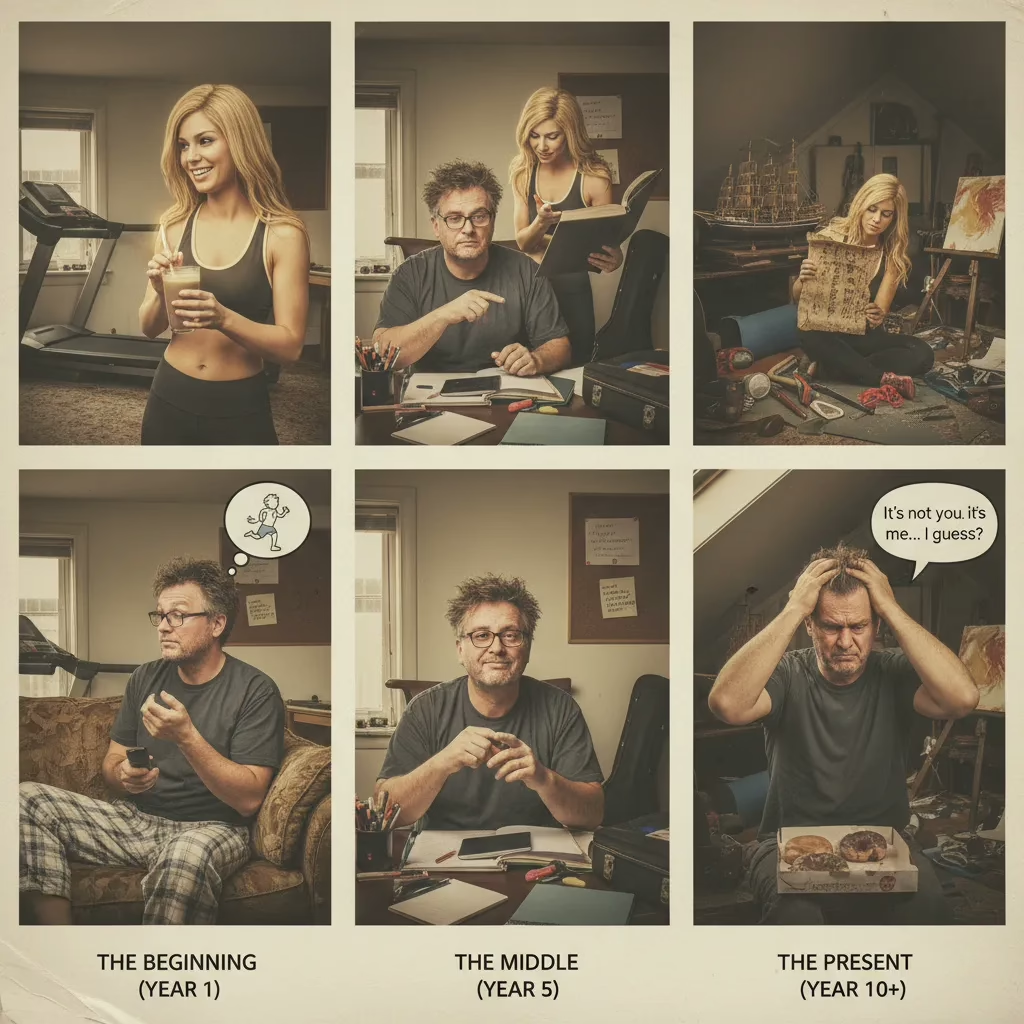
1) My long, embarrassing romance with motivation
If motivation science ever needed a cautionary tale, I’d volunteer as tribute. For years, I was stuck in what I now call the “motivation roulette” era—my output was at the mercy of sleep, mood, stress, and whatever random life event happened to pop up. It felt like I was spinning a wheel each morning: Would I wake up energized and ready to conquer, or would I hit another motivational valley and spend the day doomscrolling?
Here’s a quick snapshot of what I tried:
-
Morning routines: I journaled, meditated, and drank lemon water like my life depended on it.
-
Pump-up videos: Tony Robbins, Jocko Willink, and every “unstoppable” YouTube montage you can imagine.
-
“New week, new me” energy: Mondays were my personal Super Bowl—until about 2 p.m., when motivation failed and I’d crash back to reality.
The problem? None of it lasted. I’d get a burst of adrenaline, confuse it for commitment, and then—poof—it was gone. I kept mistaking that initial rush for real progress. But as soon as the hype faded, so did my productivity. I was living proof of what motivation science calls the “motivation fails” cycle: high hopes, quick burnout, repeat.
It finally clicked for me when I realized intensity feels productive, but consistency actually is. I’d been chasing the high of big, dramatic starts, but I never built anything sustainable. My goals were always somewhere in the distance, which meant I was constantly falling into motivational valleys—those stretches where progress felt invisible and momentum vanished.
James Clear says it best:
“You do not rise to the level of your goals. You fall to the level of your systems.”
Looking back, my “motivation romance” was really just a series of short-lived flings with hype. I was relying on feelings, not frameworks. And as research shows, systems create frequent progress markers that keep momentum alive, while distant goals often leave us stranded in those valleys. The adrenaline rush was never commitment—it was just noise before the inevitable crash.
2) The Progress Principle: why tiny wins hit harder than big plans
Here’s the truth: my mood doesn’t care about my big ambitions. It cares about movement. That’s the heart of the Progress Principle—the idea that frequent progress, even in small doses, fuels motivation and productivity far more than distant, grand goals. Harvard researcher Teresa Amabile put it best:
“Progress is one of the most powerful motivators in the modern workplace.”
I used to set massive goals—“write a book,” “launch a course”—but on a rough day, those ambitions felt emotionally invisible. The gratification window was just too far away. When the finish line is six months out, it’s easy for my brain to say, “Why bother today?” That’s when I started leaning into small wins and building a feedback loop that actually worked.
My “Small Wins” Trick
I stopped aiming for masterpieces and started defining the smallest version of a task that still counted. For writing, that meant publishing a messy draft instead of waiting for perfection. Some days, my “win” was just outlining a single paragraph. But here’s the wild card: progress is like keeping the receipt. Even if the thing was tiny, I had proof I’d done it.
Frequent Progress Beats Big Plans
There’s real science behind this. Every time I checked off a small task, it triggered a little dopamine release—my brain’s way of saying, “Nice job, do that again.” Over time, these tiny wins created a compounding repetition effect. According to research, just a 1% improvement each week adds up to a staggering 68% gain over a year. That’s the magic of systems: they leverage compounding, not willpower.
Personal Example: Writing on Low-Energy Days
On days when my energy tanked, I didn’t try to summon motivation. I just stuck to my system: open the doc, write one ugly paragraph, hit publish if it made sense. Most days, that tiny win was enough to nudge me forward. The feedback loop kicked in, and suddenly, consistency replaced intensity. Progress replaced pressure. That’s when I started seeing real results stack up.

3) Systems beat goals (but I still keep goals, quietly)
There’s a big debate in the productivity world: systems beat goals, or is it the other way around? Here’s my take after years of trial and error: clear goals set the direction, but systems make the actual progress—and save my sanity in the process.
“Goals are for losers. Systems are for winners.”
– Scott Adams
My Productivity Blueprint: The “Fixed Content Schedule”
Let’s get real. My system isn’t glamorous. It’s a simple, calendar-based fixed content schedule that tells me what to work on, and when. No hype, no willpower required. Every Monday, I know what post I’m writing. Every Thursday, I know it’s editing day. If I’m tired, traveling, or just having a rough week, the system still runs. That’s the magic of a solid systems architecture: it survives bad sleep, surprise meetings, and random life chaos.
-
Clear goals: I set them quietly—like “publish 52 blog posts this year”—but I don’t obsess over them daily.
-
Daily actions: I focus on the tiny, repeatable steps (write 200 words, edit one section, schedule tomorrow’s post).
-
AI-assisted workflows: When I’m stuck, AI drafts outlines or proofreads, keeping momentum alive.
Why Systems Win (and Keep Me Sane)
Here’s what I learned: goals are like a compass, but systems are the map and the path. Research backs this up—sustained productivity isn’t a personality trait, it’s a setup. Systems-oriented goals encourage iteration and ongoing change, so I don’t slip back when life gets messy. My productivity blueprint is boring, but it works even on my lowest-energy days.
And yes, I still keep goals—just quietly, in the background. I’ve stopped worshiping them. Instead, I build repeatable workflows that make progress automatic. My systems architecture is forgiving: if I miss a day, I just pick up where I left off. No guilt, no drama.
Motivation comes and goes. My system doesn’t care if I’m inspired or exhausted. It just works. And that’s why, for me, systems beat goals every time.
4) Where AI fits: the assistant who never needs a pep talk
Here’s the honest truth: most days, my brain would rather scroll than start. That’s where my AI-assisted workflow comes in—not as a genius, but as scaffolding. AI helps me with initiating tasks, especially when motivation is nowhere to be found. It’s the assistant who never gets tired, never procrastinates, and never waits for a confidence boost. It just shows up, every time.
Let me give you a real-life scenario. It’s 9:40pm. I’m cooked. My brain is mush, and the last thing I want to do is write. But I open my notes, and with a few clicks, AI turns my scattered thoughts into a publishable draft. Suddenly, breaking inertia isn’t a battle—it’s a process. That’s the magic of an AI-assisted workflow: it helps me start, even when I’d rather quit.
How AI Helps Me Get Moving
-
Drafting outlines when I can’t focus
-
Turning bullet points into first drafts
-
Repurposing old content for new platforms
-
Generating checklists so I don’t miss steps
-
Offering gentle accountability (“You haven’t posted today!”)
It’s not about AI being smarter than me. As Ethan Mollick says,
“AI is not a replacement for your judgment; it’s a tool that changes the cost of trying.”
AI lowers the friction to initiating tasks. It’s like having a co-worker who never needs a pep talk, never calls in sick, and never loses momentum. This is especially powerful for sustained productivity, because the hardest part is often just getting started.
The Feedback Loop Upgrade
Here’s the real kicker: AI speeds up the feedback loop. I can iterate faster, see progress sooner, and that progress creates its own motivation. Research shows that while motivation helps us start, sustained productivity comes from seeing results and building momentum—a self-reinforcing feedback loop.
And yes, here’s my favorite AI joke break:
I told AI I was burned out.
It replied, “Understood. Executing anyway.”
That’s the point—automation reduces decision fatigue. AI doesn’t care if I’m tired or uninspired. It just gets to work, letting me focus on taste and judgment (the parts only a human can do). With AI as my scaffolding, I don’t need to chase motivation. I just need to show up.
5) The low-energy day protocol (aka: my burnout prevention plan)
Let’s be honest: some days, I wake up with zero spark. My brain feels foggy, my energy is flat, and the last thing I want is to “crush it.” For years, I thought these days meant failure—like I wasn’t motivated enough. But chasing motivation is a losing game. Instead, I built my burnout prevention plan: the low-energy day protocol.
Here’s my rule: every system I use needs a “minimum viable day.” That means defining the smallest daily actions that keep my momentum building, even when I’m running on empty. For example, if I can’t do my full workout, I walk for 10 minutes. If I can’t write a full blog post, I jot down a single idea or outline. This isn’t about lowering standards—it’s about protecting the compounding power of repetition. Consistency, not intensity, is what fuels continuous improvement and real habit formation.
There’s a reason for this. Research shows that systems—those boring, repeatable routines—outperform goal-only approaches for momentum building and burnout prevention. When I stopped glamorizing the grind and started respecting my limits, I actually got more done. The culture loves to celebrate all-nighters and hustle, but I’ve learned that progress comes from showing up, even in small ways, every single day. As BJ Fogg says,
“People change best by feeling good, not by feeling bad.”
Intrinsic motivation—doing work that matters to me, at a pace I can sustain—beats any external reward or fleeting burst of hype.
So, on low-energy days, my protocol is simple: do the minimum, keep the system alive, and let the habits reinforce themselves. It’s like laying railroad tracks for a train. Even when the fog rolls in and I can’t see the destination, the tracks guide me forward. That’s how I protect my momentum and prevent burnout—by making sure my systems work, even when I don’t feel like working.
If you’re tired of starting over every Monday, stop chasing motivation. Build systems that keep you moving, even on your worst days. That’s where real, sustainable progress begins.
TL;DR: Motivation fails in predictable valleys. Systems beat goals because they create frequent progress and a feedback loop you can repeat. Add AI as a tireless assistant (not a replacement brain), and you get sustained productivity without burnout.