
I remember sitting in a motel parking lot at 2 a.m., laptop glowing, trying another weekend launch. Discipline wasn’t the problem—I was a former platoon sergeant—but I felt stuck in ‘waiting for orders’ mode. That old wiring made me test tactics without committing to a system. In this post I’ll share the identity shift that changed my trajectory: switching from reactive hustler to deliberate operator. I’ll pull in veteran-specific funding pathways (Canada 2026 notes), practical steps to build evergreen funnels, and a simple exercise that made a $10K/mo business feel inevitable.
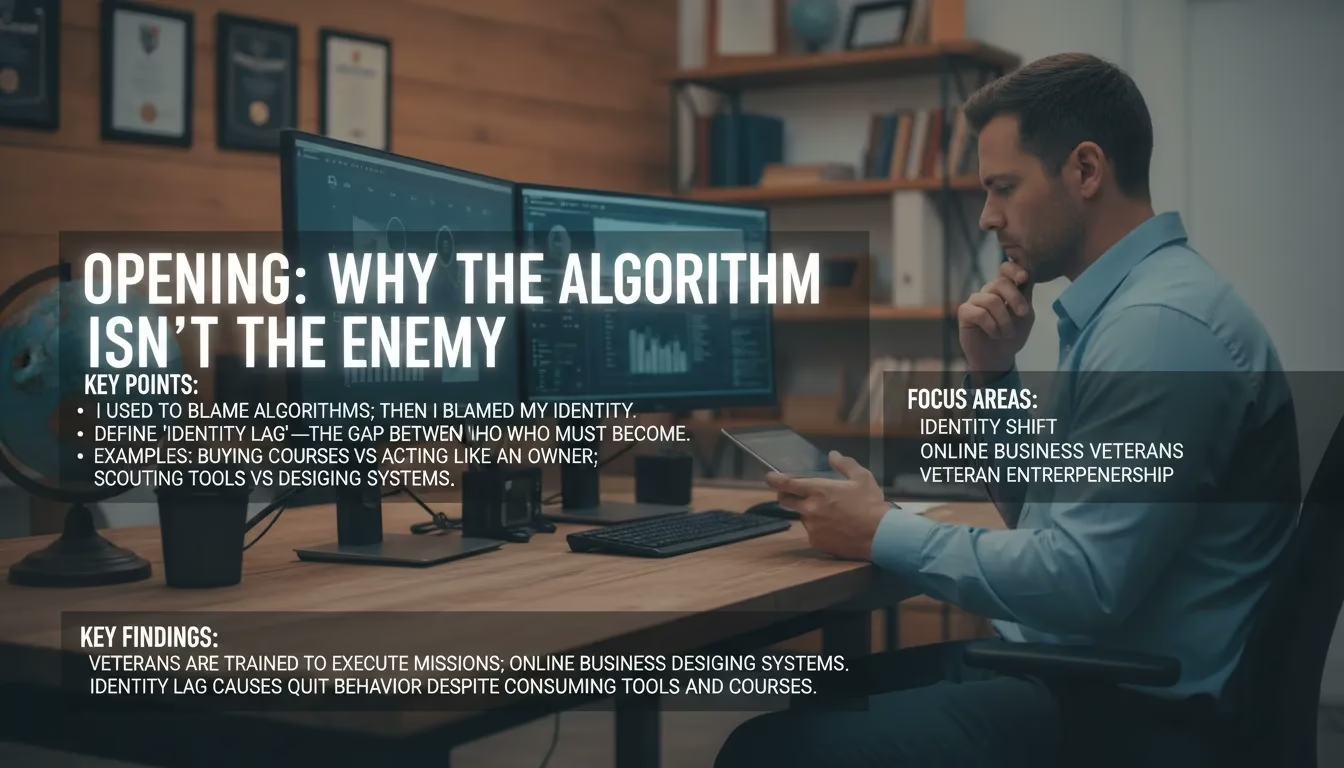
Opening: Why the Algorithm Isn’t the Enemy
I used to blame the algorithm for everything. My posts didn’t get reach. My videos stalled. My “launch” flopped. I told myself the platforms were rigged, that Veteran Entrepreneurship was harder online because the game kept changing.
Then I realized something that hit harder than any shadowban: the real problem wasn’t the algorithm. It was my Identity Shift that never happened.
Identity Lag: The Gap That Makes Online Business Veterans Quit
Identity lag is the space between who you are today and who you must become to run the business you say you want. Most Online Business Veterans don’t struggle because they lack discipline. We’re trained to execute missions. But online business requires designing systems—and that’s a different muscle.
When I stayed in “executor mode,” I kept waiting for orders: a perfect strategy, a perfect niche, a perfect tool. And when results didn’t show up fast, I quit like it was a bad mission plan instead of a normal business cycle.
Courses and Tools Don’t Fix a Missing CEO Identity
I bought courses like they were gear. I collected AI tools like they were weapons. I watched tutorials late at night and felt productive—until it was time to publish, follow up, and improve.
-
Buying courses felt like progress, but I wasn’t acting like an owner.
-
Scouting tools felt smart, but I wasn’t designing systems.
-
Weekend bursts felt intense, but they weren’t consistent.
I remember one late-night launch where I stayed up tweaking headlines and graphics, convinced the “right” setup would save it. It didn’t. Not because the platform hated me—because I never stepped into the CEO role that runs the same process daily.
What the Algorithm Actually Rewards
The algorithm rewards what business rewards: consistency and systems. Publish. Track. Optimize. Not random sprints.
Jonathan Montoya: “Content must begin with the end in mind—so must your business identity.”
Quick takeaway: choose the identity first—operator, builder, CEO—then learn tools with purpose, aimed at the system that gets you to $10K/month.
Why Identity Drives Systems (Not the Other Way Around)
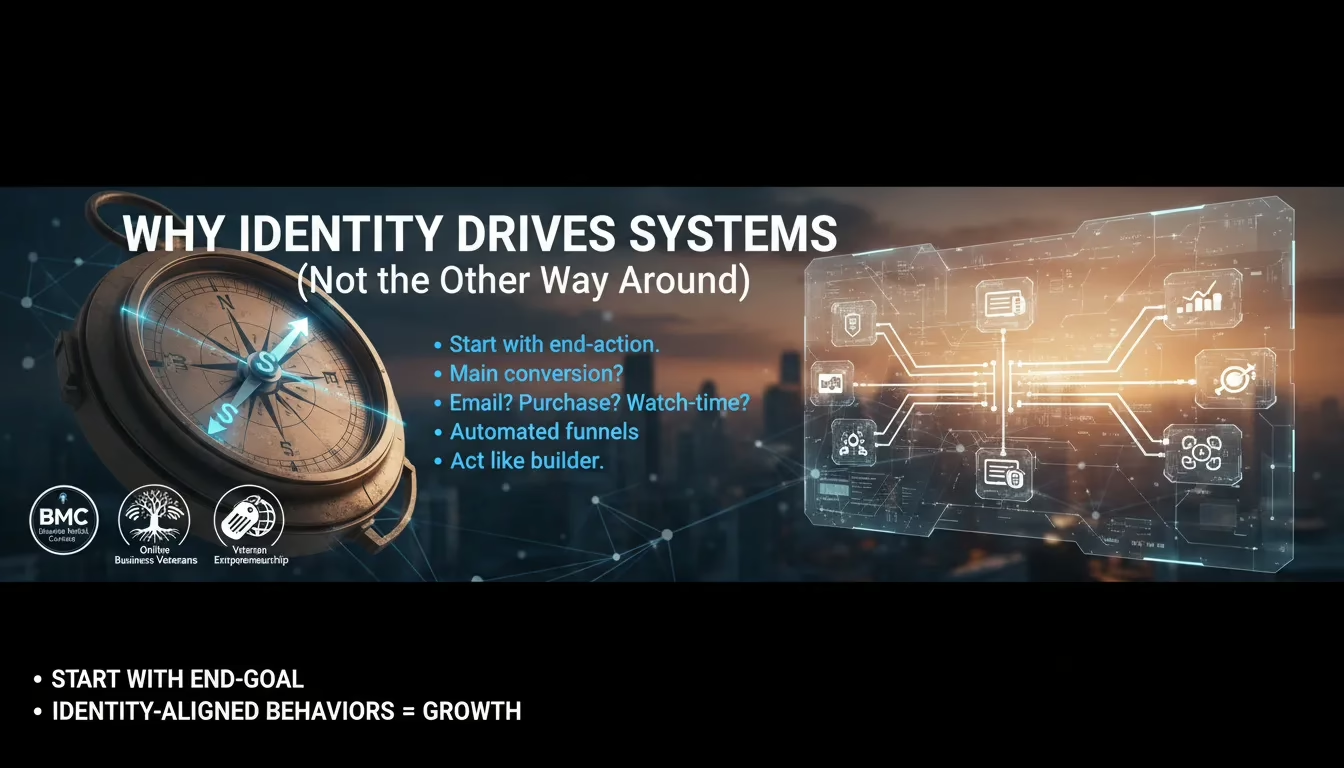
I learned to frame business like mission design. In the military, we didn’t start with “what tools do we have?” We started with the end state. For Online Business Veterans, that same rule applies: start with the end-action you want a visitor to take, then build the system that makes it happen.
Start With the Main Conversion (Not Random Content)
Before I touch a new tool, I ask one question: What is the main conversion? Is it an email signup, a purchase, or watch-time that feeds evergreen YouTube traffic? This is where the Business Model Canvas helps me stay clear—value, customer, channel, and revenue all point to one primary action.
Jonathan Montoya’s structured SEO planning idea is simple: content must be built with the end in mind. I apply that to Veteran Entrepreneurship too. If the goal is funnel opt-ins, then every page, video, and email has one job: move the visitor to that opt-in.
Identity-Aligned Behavior Builds the Machine
Here’s the hard truth: systems don’t create identity. Identity creates systems. If I still see myself as “trying this online thing,” I’ll build half a funnel and stop. But when I act like the CEO, I build even when I don’t feel like it.
Col. Aaron Blake (Ret.): “When you act like the CEO, your calendar, not your feelings, runs the business.”
I proved this to myself when I changed my weekly cadence to: “I publish. I track. I optimize.” Within weeks, my output got cleaner. Within months, the results started to compound—because my behavior finally matched the business I said I wanted.
Action Steps: Install the CEO Identity
-
Pick one primary metric for the next 30 days: email list growth, funnel opt-ins, or evergreen traffic.
-
Map daily behaviors that prove your identity: write 300 words, record one short video, review analytics for 10 minutes.
-
Build weekly: if you want automated funnels, act like someone who builds funnels every week.
Veteran leadership skills translate directly into structured business systems. The difference is now you design the mission—and your identity sets the standard.
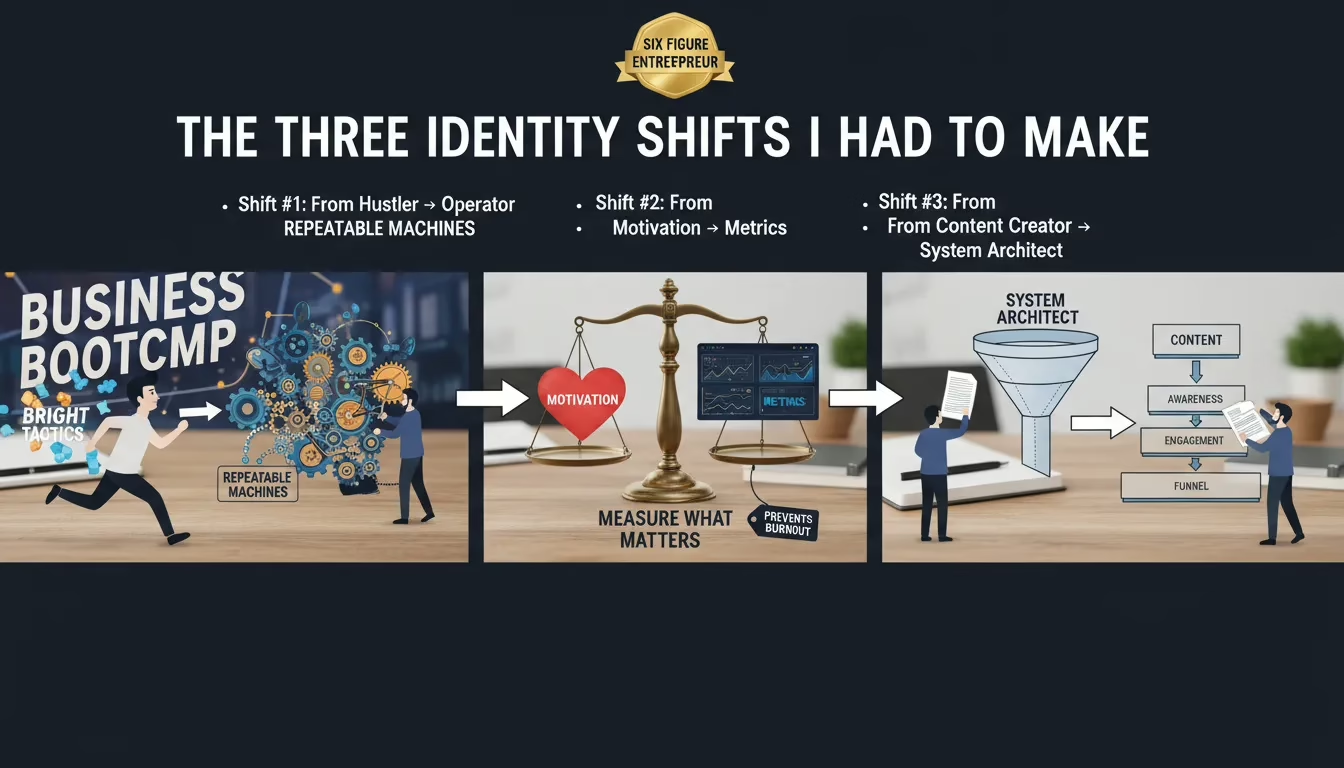
The Three Identity Shifts I Had to Make
Identity Shift #1: From Hustler → Operator (Business Bootcamp mindset)
At first, I chased every bright shiny tactic: new AI tools, new platforms, new “secret” strategies. That was my old wiring—execute fast, move on. But online business doesn’t reward constant motion. It rewards repeatable machines.
What changed me was treating my business like an operation. A Business Bootcamp and other structured programs helped because they forced me to map the system (like a simple Business Model Canvas) instead of winging it. That structure accelerated my operator transition—and it stopped the chaos.
Identity Shift #2: From Motivation → Metrics (how I became a Six Figure Entrepreneur)
I used to rely on motivation. If I “felt good,” I posted. If I didn’t, I disappeared. That’s not leadership—that’s mood management.
My first six launches failed because I measured vanity metrics: views, likes, and comments. I thought attention meant progress. It didn’t. When I finally tracked conversions, everything got clearer—and burnout dropped because decisions became simple.
-
Conversion rate % (opt-in and sales)
-
Email list growth per month
-
LTV (customer lifetime value in dollars)
-
CAC (customer acquisition cost)
Measuring the right metrics kept me steady. That’s a big part of how I started thinking like a Six Figure Entrepreneur—not because I “worked harder,” but because I worked cleaner.
Jonathan Montoya: “Design with the end in mind; the identity follows the system you build.”
Identity Shift #3: From Content Creator → System Architect (systems compound)
Posting alone is noise. Systems compound. My biggest Identity Shift was making content a component of a funnel, not the whole plan.
Example: YouTube videos drive to a free checklist → email signups → an automated product launch sequence. Now content has a job.
Once my systems started scaling, I leaned into veteran-owned branding too. In 2025 data, veteran-owned products can command about a 12% price premium—but only after the delivery system is consistent.
Micro-habits that made it real
-
Weekly KPI review (15 minutes, same day each week)
-
90-day system sprints (one funnel improvement at a time)
-
Templates for repeatable funnels and emails
The Identity Exercise: Act Like a $10K/month Operator
I use one question to snap out of “waiting for orders” mode and into CEO mode:
If I were already running a $10,000/month automated business, how would I act this week?
Then I do that—before the money shows up. For Online Business Veterans, this is the fastest way I’ve found to close the identity gap.
Col. Aaron Blake (Ret.): “Act like the revenue already exists and your decisions shift overnight.”
Runway Phase (Months 1–6): Behave Like You’re Validating, Not Dreaming
In the Runway Phase, I’m not trying to look successful. I’m trying to prove what sells through fast testing. If you’re in Canada, using a veteran stipend or ETB can be part of a Financial Bridge Strategy—funding validation without taking reckless risks.
Operator Actions (Not “Busy Work”)
-
Time-block publishing: I schedule content like PT—non-negotiable.
-
Run a split-test: headline A vs B, offer A vs B, subject line A vs B.
-
Delegate one repeatable task: thumbnails, editing, posting, or VA research.
-
Set funnel goals: leads/day, opt-in rate, and one conversion target.
Small Wins That Prove I’m Building a Machine
-
Ship a lead magnet (simple checklist beats a perfect ebook).
-
Create a welcome email sequence (3–5 emails, written once).
-
Instrument conversion tracking so I can see what’s working.
My “$10K Operator” Week Plan
|
Day |
Identity-Based Behavior |
Output |
|---|---|---|
|
Mon |
Commander’s intent |
One KPI dashboard + weekly targets |
|
Tue |
Publish on schedule |
1 post/video + CTA to lead magnet |
|
Wed |
Optimize, don’t guess |
Split-test live ( |
|
Thu |
Delegate like a CEO |
One SOP + task handed off |
|
Fri |
Review metrics |
Fix one bottleneck in the funnel |
When I “pretended I had command authority again,” my choices changed fast: I set a real budget, hired help sooner, and stopped chasing random tactics. To scale the exercise, I repeat it monthly, review metrics, and raise the stretch target to $20K/month—not for ego, but to force better decisions.
Veteran-Specific Resources, Funding, and Programs (Canada 2026 focus)
When I started building an automated online business, I learned fast that willpower isn’t the only fuel—runway matters. The good news is that Veteran Business Funding in Canada 2026 is more real than most of us think. Canada offers veteran-focused grants, loans, and training pathways that let you test a business model without draining personal savings (see fsidigital.ca).
Education Training Benefit (ETB) as Months 1–6 Runway
The Education Training Benefit can be a smart way to fund the “validation phase” (months 1–6): learning, building, and proving demand before you scale. Pairing ETB with a short bootcamp gives you structure and time to publish, track, and optimize—without panic spending.
BDC Veteran Entrepreneur: Leadership Counts as Experience
If you’re looking at lending, the BDC Veteran Entrepreneur approach is different from traditional credit conversations. They recognize that military leadership is business-relevant.
BDC Representative Sarah Milton: “We view military leadership as a strong proxy for entrepreneurial potential.”
That matters because it validates what we already know: we can operate under pressure, build teams, and execute systems—exactly what online businesses require.
Bootcamps + Non-Repayable Investment ($5,000–$10,000)
One option I’d point veterans to is the free 6-week Veteran Business Boot Camp (vetbootcamp.ca). It’s practical: Business Model Canvas work, coaching, and accountability.
-
Cost: Free
-
Length: 6 weeks
-
Outcome: Clear offer + model you can test fast
-
Funding: Bootcamp grads may qualify for a non-repayable $5,000–$10,000 investment after a video submission
Training and Community That Builds Visibility
For skill-building, the University of Ottawa offers a Certificate in Entrepreneurship and Innovation tailored for veterans.
Dr. Emma Laurent (University of Ottawa): “Tailored education speeds veteran transitions into entrepreneurship.”
For network and momentum, events like the Evolve Forum (iwscc) and the Canadian Legacy Project create mentorship and visibility—especially powerful when you lean into Veteran Owned branding, which has shown a ~12% price premium in North America (2025 data).
Designing Automated Systems: Funnels, AI, and Evergreen Traffic
Once my identity shifted from “taking orders” to “designing missions,” automation stopped feeling like a tech hobby and started feeling like leadership. In an Online Business, systems are how I scale without burning out. This is my Digital Transformation: building machines that work even when I’m offline.
Sasha Reed, Funnel Specialist: “Automation lets veterans leverage discipline into repeatable revenue.”
Start With the End: Market Validation + Business Model Canvas
Before I build anything fancy, I use Market Validation to confirm people want the offer. Then I map the flow on a simple Business Model Canvas: who I serve, what I sell, how I deliver, and how I get traffic. That keeps me from chasing random tactics.
The Core Funnel Components (Simple, Repeatable)
-
Lead magnet (checklist, template, mini training)
-
Email sequence (5–7 emails that teach + build trust)
-
Evergreen webinar or product page (same pitch, always running)
-
YouTube funnel (evergreen videos that point to the lead magnet)
My Example Stack: YouTube → Lead Magnet → Email → Evergreen → Membership
I publish one helpful YouTube video each week. Every video sends people to one clear action: download the lead magnet. The email sequence does the heavy lifting, then routes subscribers into an evergreen funnel that sells a membership.
How AI Speeds Testing (Without Losing My Voice)
AI gives me speed to validation. I use it to:
-
Turn one long video into shorts and posts (repurposing)
-
Generate outlines fast so I publish consistently
-
Test copy variants for headlines, emails, and landing pages
Metrics Over Motivation: The KPI Dashboard
I don’t optimize feelings—I optimize numbers. I track:
|
Metric |
Example |
|---|---|
|
Conversion rate |
25% opt-in |
|
Email growth |
+300/month |
|
CAC |
$40 per customer |
|
LTV |
$240 per customer |
Weekly Cadence + 90-Day Optimization Sprints
Evergreen funnels compound when I publish consistently. Each week: publish, review KPIs, adjust one thing. Every 90 days: one focused sprint to improve the biggest bottleneck.
Roadmap: From Runway to Scale (Practical Calendar)
I treat my business like a mission plan: clear phases, clear milestones, and a calendar I can follow even on low-motivation days. That’s how I turn identity into action. As Lt. Col. Sarah Ellis (Ret.) said:
“A mapped runway turns uncertainty into predictable experiments.”
Runway Phase (Months 1–6): Validate Before You Expand
In the Runway Phase, my job is not to look like a CEO—it’s to prove the offer works. Research backs this up: structured runways with veteran resources shorten time to validation, because I’m not guessing alone. I use a Business Bootcamp plus mentorship to move faster, collect real feedback, and tighten my message.
-
Validate one offer with real buyers
-
Collect customer feedback weekly
-
Refine messaging until it’s simple and repeatable
90-Day Sprint Template (Repeatable)
-
Month 1: Build a lead magnet + simple funnel (
opt-in → email sequence → offer) -
Month 2: Scale content + automation (schedule posts, automate follow-ups)
-
Month 3: Optimize conversions + hire (contractor for editing, design, or admin)
Financial Bridge Strategies (Reduce Personal Risk)
I don’t “white-knuckle” the runway. I plan it. A Financial Planning Workshop helps me map burn rate and runway length, then choose a bridge option:
-
ETB stipend or pension support during validation
-
Small loans for tools and ads (only after basic proof)
-
Non-repayable investments of $5,000–$10,000 to move from runway to early scale
Scale Phase (Post-Validation): Build the Machine
Once I’m validated, the Scale Phase is where I start acting like a Six Figure Entrepreneur: I systemize sales, hire contractors, and increase paid acquisition with discipline.
Key Milestones (Clear, Measurable)
-
First 100 email subscribers
-
First $1,000 revenue month
-
Path to $10,000/month target
Operator Identity Checklist
-
Documented processes (SOPs) for content, sales, and support
-
Weekly KPI review (traffic, opt-ins, conversion rate, revenue)
-
Delegated tasks so I stay focused on growth
Wild Cards: Thought Experiments, Quotes, and My Slightly Messy Aside
Veteran Stack Thought Experiment: If Your Product Was a Platoon
Imagine your product is a platoon and your customer is the mission. If I had to ensure mission success, I wouldn’t “post more.” I’d build systems: clear roles, simple SOPs, a feedback loop, and a resupply plan. That’s the Veteran Stack mindset—content, email, offers, and ads working like a unit, not random acts of effort. Cross-domain thinking is where this gets fun: military planning plus marketing testing creates solutions most civilians never consider.
Quote Cluster: Veteran Entrepreneurship Resources From Unexpected Voices
Jonathan Montoya: “Begin with the end in mind.”
That line hits harder in business than it ever did in training. End state first, then systems.
BDC rep: “Small tests beat big guesses—spend a little to learn a lot.”
That’s how I think about Veteran Entrepreneurship Resources now: not as motivation, but as tools to run controlled experiments.
Dr. Emma Laurent (University of Ottawa): “Tailored education speeds veteran transitions.”
Translation: stop trying to learn like a civilian beginner. Learn like a Mission Entrepreneur—focused, measured, and built around your strengths.
Veteran leader: “If you can brief it, you can build it.”
My Slightly Messy Aside: The Launch I Missed
I once missed a launch window because I was stubborn about doing everything myself—copy, pages, emails, graphics. I told myself it was “standards.” It was really control. That failure taught me a delegation rule: if someone can do it 80% as well as me, I hand it off, because speed and consistency beat perfection.
ETB Scenario: Validate in 30 Days
What if a veteran used ETB funds to run a small paid test ad, drove traffic to one clean offer, and learned the truth in 30 days? If the market pays a 12% premium for a clearer promise, that’s not hype—that’s data.
Firmware, Hardware, and the Real Ending
Identity is firmware. Behavior is hardware. If I upgrade the firmware—“I’m an operator, not a hustler”—the output changes. This week, I want you to do one weird CEO thing: run a price increase test, tighten your offer, or ask for the sale sooner. Income follows identity, and the moment you act like the CEO, your systems start acting like a business.
TL;DR: Stop treating business like a mission you only execute when told. Rewire your identity to ‘operator’ and install systems—funnels, metrics, automation—and income follows.
Leave a Reply
You must be logged in to post a comment.