Last winter I woke up to the kind of day that makes you want to “reschedule your life.” Bad sleep, a calendar full of meetings, and exactly zero heroic energy. I still had to ship work, answer customers, and post content—so I did the only thing that didn’t require inspiration: I followed my checklist. It wasn’t glamorous. It was weirdly calming. And by lunch, I realized something that annoyed me (because it was true): my business didn’t need a better mood. It needed better business systems.
1) The day motivation ghosted me (again)
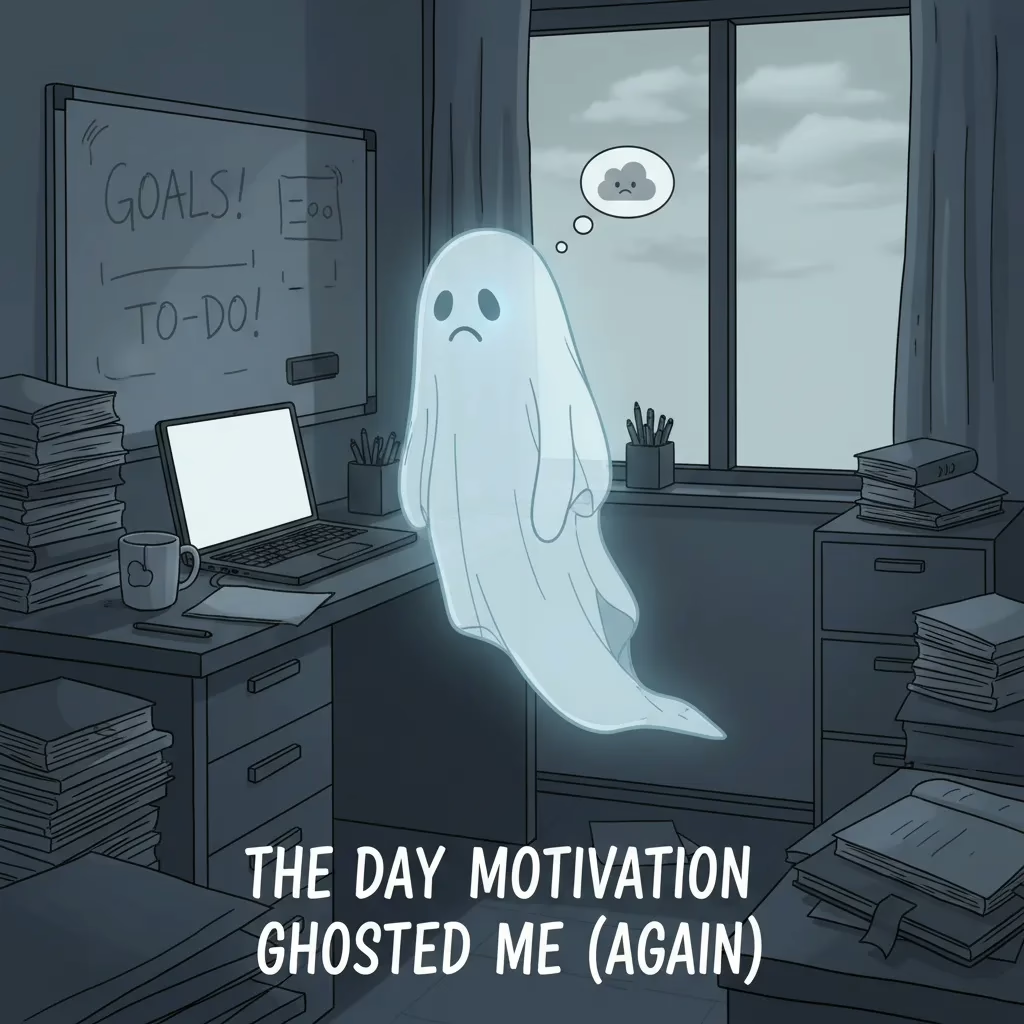
This was supposed to be the day. You know the feeling—alarm goes off, coffee in hand, and I’m convinced I’ll finally tackle the big projects on my list. By 9:17 a.m., that “let’s crush it” energy has already evaporated. Inbox dread creeps in. My to-do list looks more like a menu for anxiety than a plan for business growth. Suddenly, I’m not building my business—I’m deep-diving into “researching new tools” (read: procrastinating on YouTube and comparing project management apps I’ll never use).
Here’s my tell: when I start fiddling with templates or reading about the latest AI scheduling assistant, I’m not working. I’m hiding. It’s the business equivalent of being left on read—motivation just disappears, and I’m left staring at my screen, waiting for a spark that never comes. Real life shows up: bad sleep, a calendar full of calls, zero energy, and a Slack channel that won’t quit. Suddenly, motivation ghosts me harder than a date who never even texted back.
I used to think this meant I was lazy or undisciplined. But the truth? I was mistaking emotional hype for real momentum. I’d ride the high of a new idea or a viral post, only to crash when the algorithm got petty or my mood tanked. For creators, this is especially brutal—one day the algorithm loves you, the next it buries your best work. If your business management strategy is built on feelings, you’re in for a wild (and exhausting) ride.
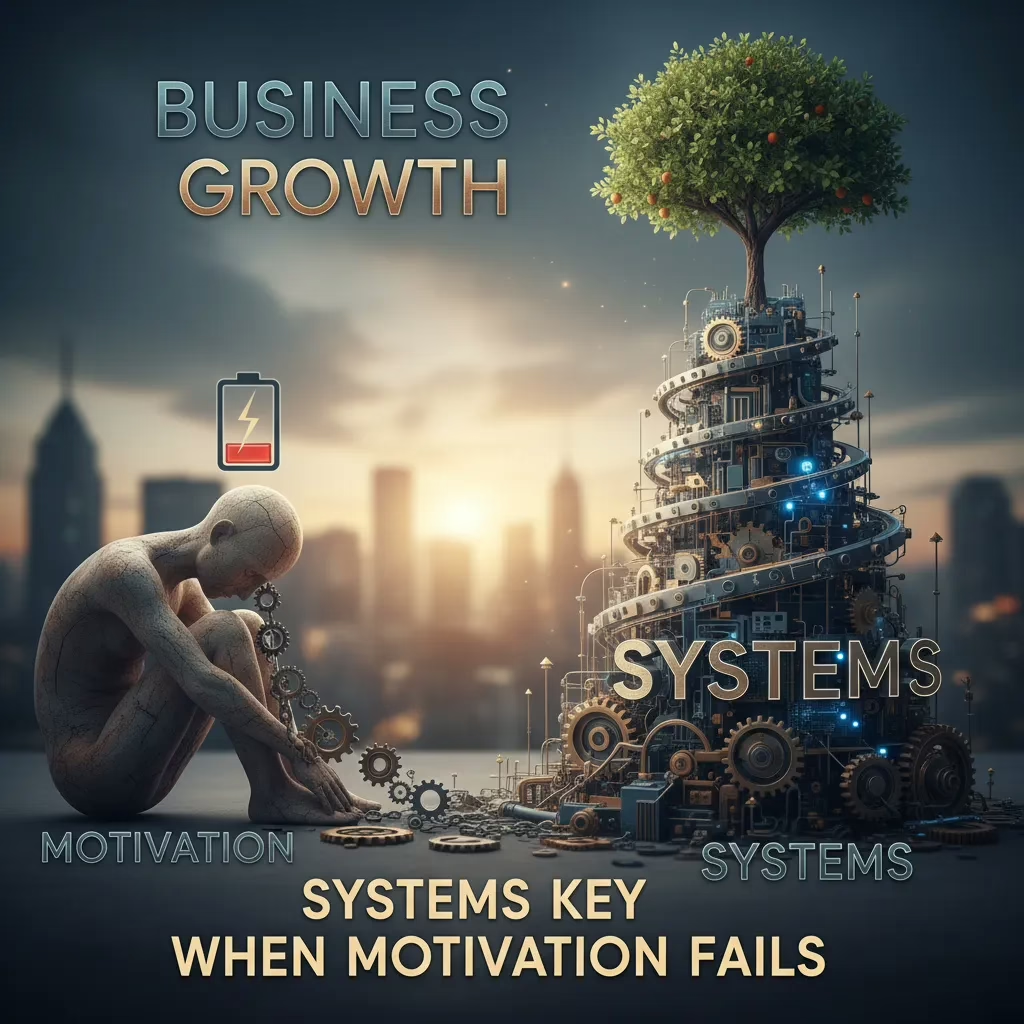
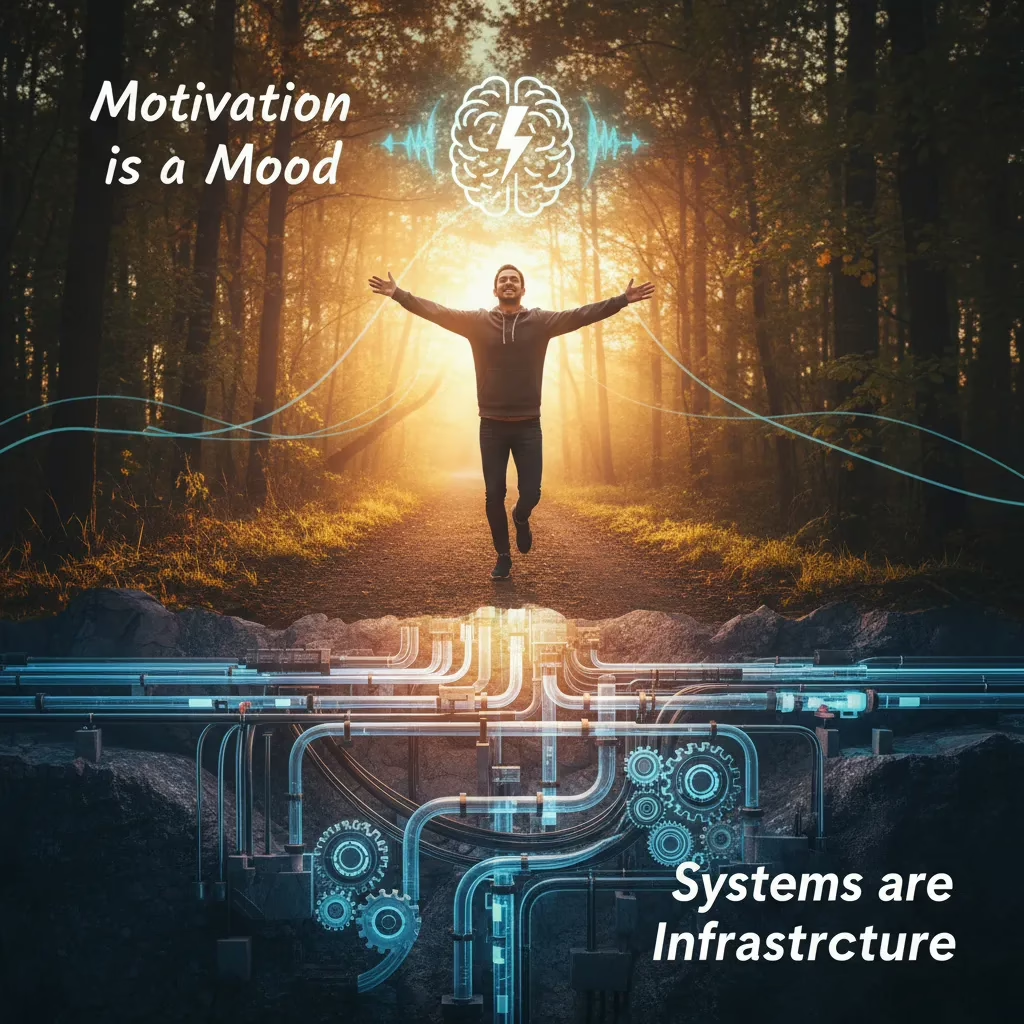
Here’s where the real contrast comes in: motivation is a mood; business systems are infrastructure. Motivation depends on how I feel. Business systems—repeatable business processes, checklists, and routines—don’t care if I’m tired or if my coffee is cold. They show up, rain or shine. As James Clear puts it:
“You do not rise to the level of your goals. You fall to the level of your systems.”
When the founder’s mood is the operating system, the company crashes. But when operational efficiency is built on standardized business systems, results become reliable—even on the days when motivation is nowhere to be found. No 47-step morning routine required. Just a simple, sturdy process that holds up on the worst days, not just the best ones.
2) Motivation is a mood; systems are infrastructure
Here’s what finally clicked for me: motivation is like the weather—unpredictable, sometimes sunny, sometimes stormy. But systems? They’re the infrastructure. The boring stuff that keeps the lights on in your business, even when you’d rather hit snooze. Think of systems as the pipes and wiring behind the walls. You don’t notice them when everything’s working, but you sure miss them when they’re gone.
Motivation depends on how I feel when I wake up. Systems don’t care. They don’t negotiate with my mood, my energy, or whether I had a rough night. That’s the freedom: I don’t have to feel ready to get things done. The system tells me what to do, and I just show up.
Why SOPs and Checklists Work (Without Going Full Bootcamp)
The military doesn’t wait for motivation. It runs on SOPs, checklists, and processes. Not because they’re exciting, but because they work. Atul Gawande nailed it:
“Checklists seem to provide protection against such failures.”
These tools create operational efficiency by simplifying procedures and eliminating bottlenecks. They reduce errors, minimize rework, and keep everyone moving in the same direction. That’s the backbone of streamlined operations.
Decision Making: Letting the System Decide
Most people try to feel ready before they act. High performers act because the system tells them to. When I rely on workflow systems, I don’t waste energy deciding what’s next. Fewer restarts, less context-switching, and more progress. As David Allen says,
“You can do anything, but not everything.”
My system helps me focus on what matters most, right now.
Mini-Example: My 3-Step ‘Start Work’ Ritual
- Open my project tracker
- Review today’s top priority
- Set a 25-minute timer and start
That’s it. No elaborate prep, no waiting for inspiration. This tiny ritual removes friction and gets me moving, even on low-motivation days.
Consistency Beats Intensity
Systems create consistency—showing up, day after day, regardless of how I feel. That’s where the real results live. Not in bursts of motivation, but in the boring, repeatable actions that drive business growth and operational efficiency. When you build workflow systems that run no matter your mood, you stop relying on motivation and start relying on what you’ve built.
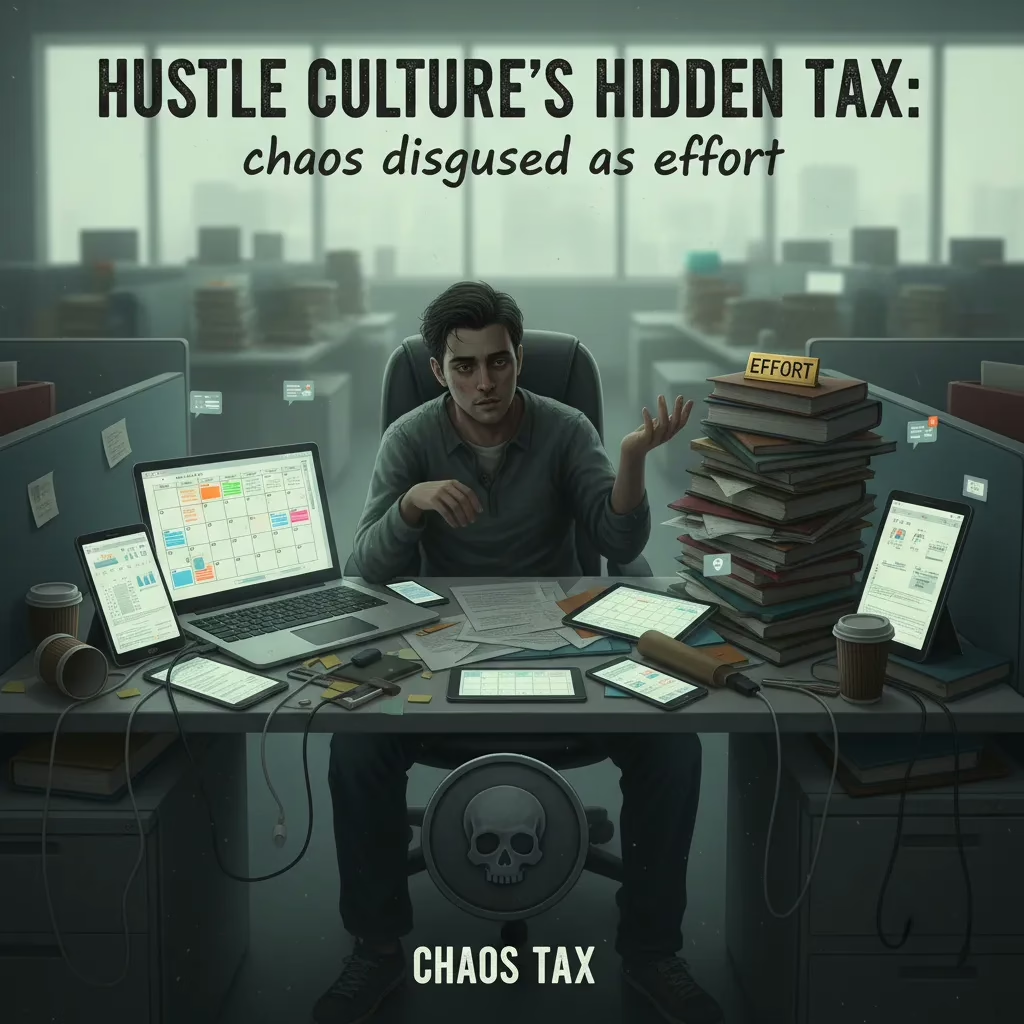
3) Hustle culture’s hidden tax: chaos disguised as effort
I used to live in the hustle loop: work harder, post more, learn more, grind longer. I’d wake up fired up, convinced today would be the breakthrough. By midnight, I’d bought another course (at 1 a.m., of course), opened 27 browser tabs—my digital cry for help—and still felt behind. The more I hustled, the less I seemed to move forward. Sound familiar?
Here’s what that chaos looked like for me:
- Jumping between strategies (yesterday: Instagram Reels, today: LinkedIn carousels)
- Chasing new tools every week (Notion, Trello, Asana—oh my!)
- Posting randomly, hoping something would stick
- Measuring nothing, so I had no clue what worked
- Second-guessing every decision
Tim Ferriss nailed it:
“Being busy is a form of laziness—lazy thinking and indiscriminate action.”
I was busy, but not progressing. My effort was real, but without direction, it was just noise. Even my tiny team (me + my VA) felt the drag. When I was scattered, she was too. Team motivation tanks fast when there’s no clear workflow or resource allocation. Productivity boost? More like productivity drain.
Here’s the real kicker: busy isn’t the same as progress. Hustle culture tricks us into thinking effort equals results. But without process optimization and workflow streamlining, you’re just spinning your wheels. Research shows productivity improves when workflows are streamlined and repetitive tasks are automated. Employee satisfaction (even if you’re the only employee) goes up when systems handle the mundane, freeing up energy for strategic work.
So what’s the antidote? Process optimization. One workflow, fewer options, clear priorities. Instead of chasing every shiny object, I started asking: what’s the one thing that moves the needle today? Suddenly, my resource allocation made sense—time flowed into what mattered, not what was urgent or shiny.
Quick hypothetical: Two founders, same hours. One runs on systems—clear tasks, automated reminders, one metric tracked. The other runs on vibes—whatever feels urgent, lots of “just in case” actions. Guess who gets the productivity boost? Who feels less overwhelmed? Brené Brown said it best:
“Choose discomfort over resentment.”
The discomfort of building a system beats the resentment of endless hustle every time.
4) The real reason systems win: they delete decisions
Let’s talk about the silent killer of business growth: decision fatigue. You know that feeling around 3 p.m. when your brain is foggy, your to-do list is a mess, and even choosing what to tackle next feels impossible? That’s decision fatigue in action. As Roy Baumeister says,
“Self-control is like a muscle. When it gets tired, it works less well.”
Every small choice chips away at your mental energy, leaving you with less for the decisions that actually move your business forward.
Here’s where systems change everything. The real magic of a system is that it deletes decisions before you even wake up. A solid system means you already know:
- What you need to do
- In what order to do it
- How long to spend on each task
- Why it matters (thanks to performance tracking and clear metrics—Peter Drucker nailed it: “What gets measured gets managed.”)
Systems have three main jobs in driving operational efficiency and business growth:
- Pick priorities: They tell you what matters today, not just what’s urgent.
- Protect focus: They shield you from distractions and last-minute pivots, reducing errors and sloppy handoffs.
- Create consistency: This is where the real results live—not in viral spikes, but in “boring repetition done right.” Consistency is the quiet compounding force that lets businesses scale and delegate as they grow.
Let me share my own shift. I used to start each day chasing whatever felt urgent—emails, Slack pings, random ideas. Now, I use a simple ‘two-hour block’ rule: every morning, I tackle my top priority for two hours, no interruptions. No more wasted energy deciding what to do next. This one change boosted my performance tracking, cut down on last-minute scrambles, and made my results predictable.
When you run your business on systems instead of moods, you make fewer mistakes, hand off tasks more smoothly, and track what actually matters. That’s how decision making becomes effortless, operational efficiency goes up, and business growth becomes a steady, reliable process—not a frantic chase for the next big thing.
5) My ‘simple daily system’ (no, it’s not aesthetic)
Let’s get real: my daily workflow system isn’t pretty. There’s no color-coded spreadsheet, no fancy Notion dashboard, no Instagrammable routine. I tried all that—once spent hours building a “perfect” business process tracker with tabs for everything. It lasted a week. Turns out, complexity kills consistency. What actually works? A simple daily system that runs whether I’m motivated or not.
The Core: My Daily System
- One primary goal for the day (the big domino)
- Three non-negotiable actions (the must-dos, no matter what)
- Clear start and stop points (so I know when I’m done)
- One embarrassingly simple metric to track (proof, not promises)
That’s it. No 47-step morning routine. No endless to-do list. Just a repeatable workflow system that keeps my business processes moving forward—even on days when motivation is nowhere to be found.
How I Pick My Metric
I keep it so simple it almost feels silly. If my main job is publishing, my metric is “Did I hit publish today?” If it’s outreach, “How many DMs did I send?” Shane Parrish said it best:
You can’t make good decisions without good information.
I want a number I can’t argue with. One glance tells me if I’m on track.
Sample Day: Creator/Business Owner
- Primary goal: Publish one valuable piece of content
- Non-negotiables:
- Write and schedule content
- Send 5 outreach emails
- Fulfill one client deliverable
- Start: 8:30 AM | Stop: 1:00 PM
- Metric: Number of content pieces published
Why I Avoid Overbuilding
Every time I’ve tried to “optimize” with more tools, I end up managing the system instead of doing the work. Productivity boost comes from doing, not organizing. Streamlined workflows and a little task automation (like auto-scheduling posts or templated emails) help, but I keep manual what matters: writing, connecting, delivering. If your system needs motivation to function, it’s not a system—it’s a wish.
Austin Kleon: “Show your work.”
That’s my rule. Simple systems, visible progress, and a workflow that runs even when I don’t feel like it. That’s how business processes compound and results show up.
6) The ‘boring weeks’ where proof shows up (and why I track it)
If you’ve ever tried to build a business system, you know the emotional timeline. Week one feels slow. You’re excited, but results are nowhere in sight. Week two? It’s boring. You’re repeating the same actions, and the novelty has worn off. By week three, it’s downright repetitive. The urge to chase a new strategy is real. But here’s the thing: this is exactly where continuous improvement and operational efficiency are born.
I track these ‘boring weeks’ for a reason. In my experience, it’s not the fireworks of motivation that create results—it’s the quiet, steady rhythm of showing up. By week four, something shifts. Patterns start to emerge. Engagement becomes steadier. Conversations with clients or customers increase. My confidence stabilizes, not because I’m working harder, but because I’m working the same way every day. That’s the first real proof that a system is working—a true productivity boost that’s data driven, not hype-fueled.
It’s tempting to measure everything, but I’ve learned to track just one key metric. One number that matters most to my business. This keeps my performance data simple and actionable. I’m not lost in twenty dashboards—I’m focused on the signal, not the noise. As research shows, data-driven decision-making starts with tracking performance metrics that actually move the needle, not just fill a spreadsheet.
Once I see a stable baseline, I can make small, smart tweaks. That’s the heart of continuous improvement. Operational stability comes from standardizing procedures and resisting the urge to overhaul everything at the first sign of boredom. It’s only after several weeks of consistency that I can spot real trends and make informed, data-driven adjustments.
There’s a quote from Annie Duke that sticks with me:
“The result of a decision is not evidence of the quality of that decision.”
That’s why I don’t judge my system by a single good or bad day. And as Seth Godin says,
“The only purpose of starting is to finish.”
I remind myself that my future self will thank me for showing up ugly, tired, or unmotivated for 30 days straight. Because that’s when the proof finally shows up—and the real business growth begins.
7) Why People Quit Right Before It Works (Patience Is a System Too)
Let’s name the core failure up front: systems fail for one reason—people abandon them too early. I’ve done it myself. I’d get excited about a new business system, run it for a week or two, and then—when things felt slow or boring—I’d jump ship. I called it “pivoting” or “strategizing,” but really, I was just chasing excitement instead of results.
Here’s the expectation mismatch that trips up so many entrepreneurs: we crave excitement, but systems deliver results. And those results? They compound quietly, like interest—powerful, but less fun to talk about at parties. The first week of a new process feels slow. The second week is repetitive. By the third, you’re questioning everything. But if you stick it out, by week four, patterns emerge. Engagement stabilizes. Progress becomes visible. That’s when scalable growth starts to show up—not in the first few days, but after consistent, repeatable action.
“Consistency is more important than intensity.”
— Simon Sinek
Here’s the trap: when results don’t show up fast enough, we assume the system is broken. So we switch methods, tools, or strategies, hoping the next thing will be “the one.” But the truth is, business scalability and scalability predictability are built on giving systems time to reveal their rhythm. Abandoning a process early is like digging up seeds to check if they’re growing.
I’ve been guilty of this “system-hopping” myself. It feels like progress, but it’s just disguised impatience. The real issue isn’t the system—it’s our lack of patience. As Angela Duckworth puts it:
“Enthusiasm is common. Endurance is rare.”
— Angela Duckworth
If you want your business systems to support team motivation and true business growth, set a practical guardrail: commit to a minimum run—say, four weeks—before judging or tweaking your system. This is how you build scalable, predictable processes that allow for easy delegation and expansion. Patience isn’t just a virtue; it’s a system in itself. Give your process time to work. That’s where the real, compounding results live.
8) Where Motivation Still Belongs (and How to Use It Without Depending on It)
Motivation is powerful, but it’s not meant to be the engine of business growth. I learned this the hard way when I started hiring help and delegating. At first, I thought if I could just keep everyone fired up, we’d crush our goals. But real life—deadlines, distractions, and days when nobody feels “on”—showed me that motivation is more like a match than a stove. It’s great for lighting the fire, but it burns out fast. The real heat comes from the system you build.
Give Motivation a Job: The System’s Architect
Here’s where motivation truly belongs: at the very beginning. Use that initial spark to:
- Design your workflow system—map out what matters most for business management and resource utilization.
- Clarify your goals—get the team excited about the “why.”
- Set the direction—define what success looks like for everyone involved.
Once the system is in place, motivation becomes optional. The process, not the mood, keeps things moving.
Employee Empowerment: Clarity Creates Autonomy
Dan Pink said it best:
“Autonomy is the antidote to disengagement.”
When I gave my team clear expectations through SOPs and handoffs, something shifted. People stopped second-guessing themselves. Stress dropped. Team collaboration improved because everyone knew their role and how their work fit into the bigger picture. This is employee empowerment in action—clarity gives people the freedom to do their best work.
How This Looks in a Small Team
- We replaced endless “quick calls” with documented processes.
- Handoffs became seamless—no more dropped balls.
- Everyone knew what to do, in what order, and why it mattered.
Stephen R. Covey’s words ring true here:
“The key is not to prioritize what’s on your schedule, but to schedule your priorities.”
Tools: When CRM and ERP Actually Help
Workflow systems like CRM and ERP only add value after your process is clear. I learned not to rush into fancy tools. First, we built the system—then we layered on technology to enhance customer care and adaptability. Integration works best when it supports, not replaces, your core process.
Wild Card Analogy: Match vs. Stove
Motivation is the match. The system is the stove. Use the match to get things started, but rely on the stove to keep the business running—no matter how you feel that day.
9) Conclusion: Momentum is Trust (and Trust Is Built Daily)
If there’s one lesson business growth has taught me, it’s this: momentum isn’t about energy or hype—it’s about trust. Not trust in luck, or even in yourself on your best day, but trust in the system you’ve built. Motivation feels great when it’s there, but as I learned on countless groggy mornings—when sleep was bad, the schedule was packed, and motivation was nowhere to be found—systems are what keep the wheels turning. That’s the quiet power behind operational efficiency and process optimization: they don’t care how you feel. They just work.
Every time you show up and run your business systems, especially on the days you’d rather not, you’re making a deposit into your own trust account. Completed days stack up. Patterns emerge. Confidence grows. Suddenly, consistency isn’t a struggle—it’s just what you do. That’s the compounding loop: each day you follow your process, you trust it more. Each time you trust it, it gets easier to keep going. That’s how continuous improvement happens, quietly and reliably.
Benjamin Franklin said, “By failing to prepare, you are preparing to fail.” Systems are your preparation. They simplify procedures, eliminate bottlenecks, and ensure you’re not reinventing the wheel every morning. Marie Forleo reminds us, “Clarity comes from engagement, not thought.” You don’t need to overhaul your life or wait for the perfect plan. Just start. Pick three actions that actually move your business forward. Decide the order. Make them repeatable. That’s your foundation for reliable business growth and operational efficiency.
So, here’s your next step—simple, practical, and proven: What are the three actions that move your business forward? In what order should they happen? How can you make them repeatable? Build your system around those answers. Then run it. Every day. Especially on the days you don’t feel like it. That’s where the real results live—not in bursts of motivation, but in the quiet trust that your process will carry you through.
I’ll be right here, running my system, one day at a time. See you tomorrow—same system.
TL;DR: Motivation starts things; systems finish them. Build a tiny daily workflow system (one goal, a few non-negotiables, one metric) to reduce decision fatigue, improve operational efficiency, and create consistent business growth.