A lot of veterans get stuck in civilian business for one simple reason.
They bring military discipline into a world full of noise, but nobody hands them a mission plan.
So they do what high-performers always do.
They push harder.
They post more.
They watch more videos.
They stay “busy.”
And somehow, nothing moves.
That is the trap.
The internet loves to tell people to work harder, stay consistent, and grind longer. That sounds noble. It also burns people out fast.
Veterans do not need more hustle.
They need a system.
That is the real mindset shift.
The problem is not discipline
Most veterans already know how to wake up early, follow through, and do hard things when they do not feel like it.
That is not the weak point.
The weak point is usually this:
You are doing a lot of disconnected work.
One day you are making content.
The next day you are tweaking a bio.
Then you are testing a new AI tool.
Then you are watching another tutorial from a guy in sunglasses telling you this is the “one weird trick” that changes everything.
Now your business looks like a supply closet after a bad field exercise.
Stuff everywhere.
No flow.
No sequence.
No mission.
That creates frustration because effort is going out, but results are not coming back.
When that happens, most people blame themselves.
Bad move.
The issue is rarely personal weakness.
It is usually system weakness.
Veterans already have the edge
This is the good news.
Veterans are not starting from zero.
In fact, veterans often have a better foundation for business than they realize.
You already understand:
- mission focus
- repetition
- delayed gratification
- adaptability
- responsibility under pressure
- working the plan even when feelings are useless
That is a strong base.
But business rewards a different kind of discipline.
Not random effort.
Structured effort.
The civilian market does not care how hard you worked today.
It responds to clarity.
It responds to consistency in message.
It responds to trust.
It responds to follow-up.
That means the veteran advantage gets unlocked when discipline is pointed at the right sequence.
Not when it is sprayed at ten tasks like a machine gun on full panic mode.
The reframe that changes everything
Here it is.
You do not need to “work harder” to build an AI business for veterans.
You need to build one simple machine.
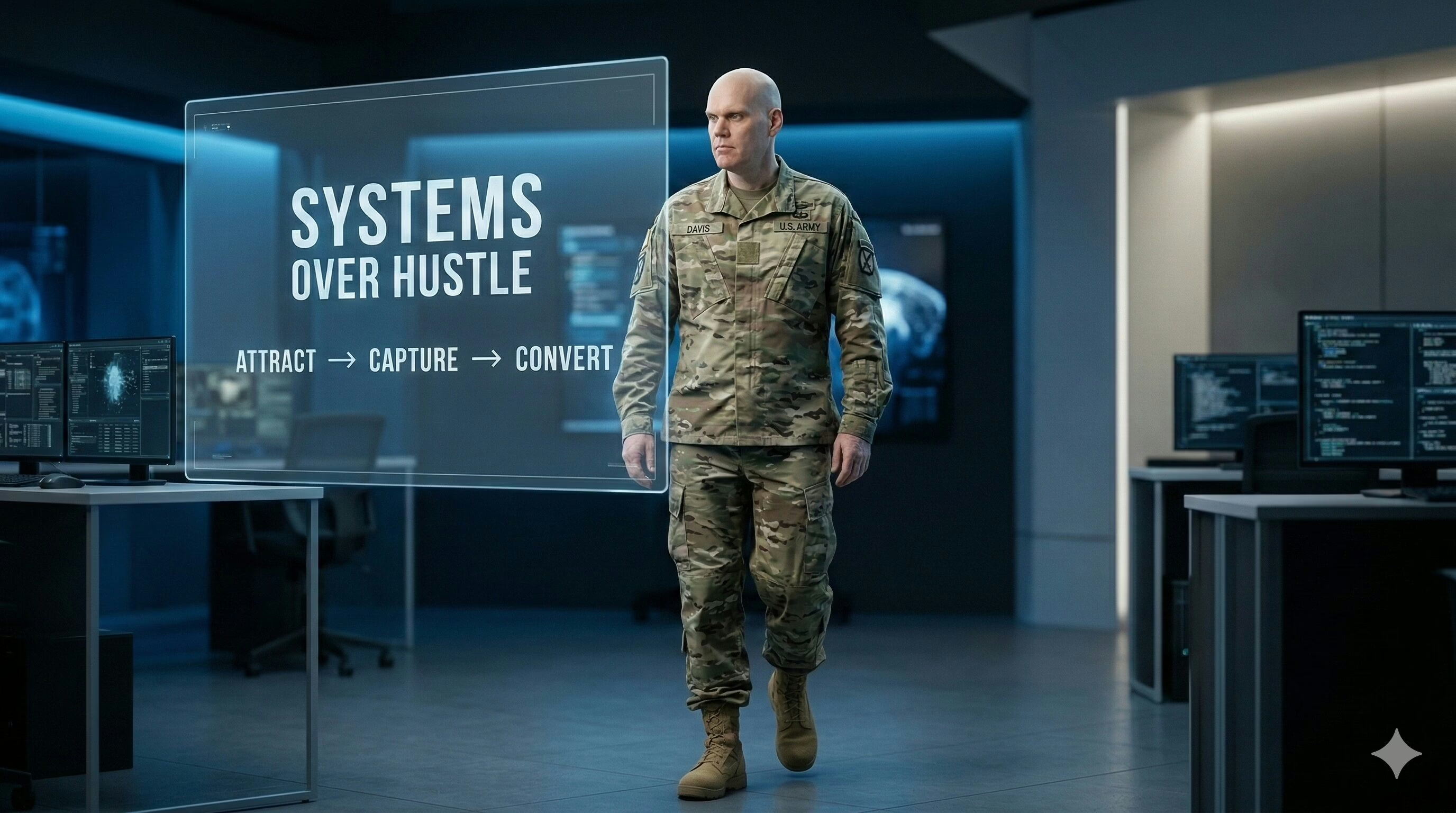
That machine has three jobs:
- Attract attention
- Capture leads
- Convert trust into sales
That is it.
Not fifty apps.
Not ten offers.
Not endless content with no destination.
A simple machine.
If you build that machine once, AI can help you make it faster, cleaner, and easier to run.
That is where AI becomes useful.
Not as a magic wand.
As force multiplication.
The 3-part AI business system
Let’s make this practical.
Here is the simple system.
1. Attract with content that solves one painful problem
Your content should not be random motivation.
It should speak to a specific pain your audience already feels.
For example:
- “Why veterans struggle to make money online”
- “The biggest mistake veterans make with affiliate marketing”
- “How to use AI when you feel behind on tech”
- “Why hustle is not the answer for veteran entrepreneurs”
That kind of content works because it meets people where they already are.
AI helps here by speeding up research, outlines, hooks, titles, email drafts, and repurposing.
But the point is not to flood the internet with content.
The point is to create useful content that pulls the right person in.
2. Capture with one simple lead asset
If people read your content and leave, you do not have a business system.
You have a hobby with Wi-Fi.
You need one next step.
That can be:
- a checklist
- a starter guide
- a short email course
- a free training
- a resource vault
- a simple blueprint
For a veteran brand, this could be something like:
“5 AI Tools Veterans Can Use to Start an Online Business Faster”
or
“The Veteran AI Income Starter Blueprint”
The lead asset should solve a small problem fast.
Not teach the whole internet in one PDF.
Just get the right person to raise their hand.
3. Convert with follow-up, not pressure
Most beginners try to sell too early or they never sell at all.
Both are a mess.
The better approach is simple follow-up.
Share proof.
Answer objections.
Tell stories.
Show the path.
Let people see that your system makes sense.
AI can help you draft email sequences, organize FAQ responses, summarize testimonials, and turn long-form content into short nurture content.
That saves time.
But the strategy still matters.
People buy when the message is clear and the path feels believable.
Not because you yelled “DM me” like a drill sergeant with a Wi-Fi hotspot.
Why this matters more than motivation
Motivation fades.
A system stays.
That is why veterans often do better when they stop trying to feel inspired and start trying to build a repeatable process.
This matters even more if you are working a job, dealing with family responsibilities, or trying to rebuild confidence after feeling stuck.
A system removes drama.
It gives your effort a place to go.
Instead of waking up and asking, “What should I do today?”
You already know:
- publish one piece of useful content
- point it to one lead magnet
- send one follow-up email
- improve one part of the funnel
Now the mission is clear.
Now your actions stack.
Now results have a chance to compound.
What a simple week can look like
Here is a realistic version.
Not fake guru fantasy land.
Monday
Write one blog post around one buyer problem.
Tuesday
Turn that blog into a short email and two social posts.
Wednesday
Create one short video from the same idea.
Thursday
Update your lead magnet CTA inside the content.
Friday
Send a follow-up email that answers one common objection.
Saturday
Review what got clicks, replies, or sign-ups.
Sunday
Reset and improve one bottleneck.
That is a system.
Not glamorous.
Not loud.
But it works because each piece supports the next one.
And that is where veterans tend to win.
Not in chaos.
In structure.
The biggest lie that keeps veterans stuck
The biggest lie is this:
“I just need to stay motivated.”
No.
You need clarity.
You need a simple offer.
You need a content-to-lead pipeline.
You need consistent follow-up.
You need fewer moving parts.
And you need to stop measuring progress by how exhausted you feel.
Being tired is not proof of traction.
That one deserves to get framed and hung in the office.
Start here
If you want to build an AI business for veterans, start with this:
Pick one problem.
Create one piece of content around it.
Offer one lead asset.
Write one follow-up sequence.
Then repeat.
That is the move.
Not building a giant empire in a weekend.
Not downloading every AI tool known to mankind.
Not redesigning your profile seventeen times because the shade of blue feels “more premium.”
One problem.
One message.
One system.
That is how momentum starts.
That is how confidence returns.
That is how veterans stop feeling behind and start building something real.
Final thought
You do not need to become a different person to win online.
You do not need to be louder.
You do not need to dance on camera.
You do not need to out-hustle everyone.
You need to organize what you already have.
Discipline.
Mission focus.
Adaptability.
Follow-through.
Those traits already exist.
Now they need a business structure.
Build the system.
Let AI help you run it.
And stop treating burnout like a badge of honor.
That mission is over.
CTA
If you are a veteran or service member who wants to build a simple AI business system without the chaos, start by creating one content piece, one lead magnet, and one follow-up sequence this week.
Then keep building the machine.
FAQ Section
What is an AI business for veterans?
An AI business for veterans is an online business that uses AI tools to speed up research, content creation, lead generation, follow-up, and sales tasks. The goal is not to replace the veteran. The goal is to give the veteran a faster, simpler system.
Do veterans need tech experience to start an AI business?
No. Most veterans do not need advanced tech skills to start. They need a clear offer, a simple content strategy, and a few practical AI tools that save time.
What is the best online business model for veterans?
The best model is usually the one that matches the veteran’s skills, experience, and available time. Affiliate marketing, coaching, consulting, digital products, and simple service offers can all work when built on a clear system.
Why do veterans struggle with online business?
Veterans often struggle because they rely on effort without a clear system. They work hard, but the content, lead generation, and sales process are disconnected.
How can AI help veteran entrepreneurs?
AI can help veteran entrepreneurs write faster, brainstorm content, organize ideas, draft emails, summarize research, and repurpose content across platforms. It works best when paired with a simple business system.
Leave a Reply
You must be logged in to post a comment.